ZEISS Intraoperative Fluorescence Technologies
Discovering the previously unseen
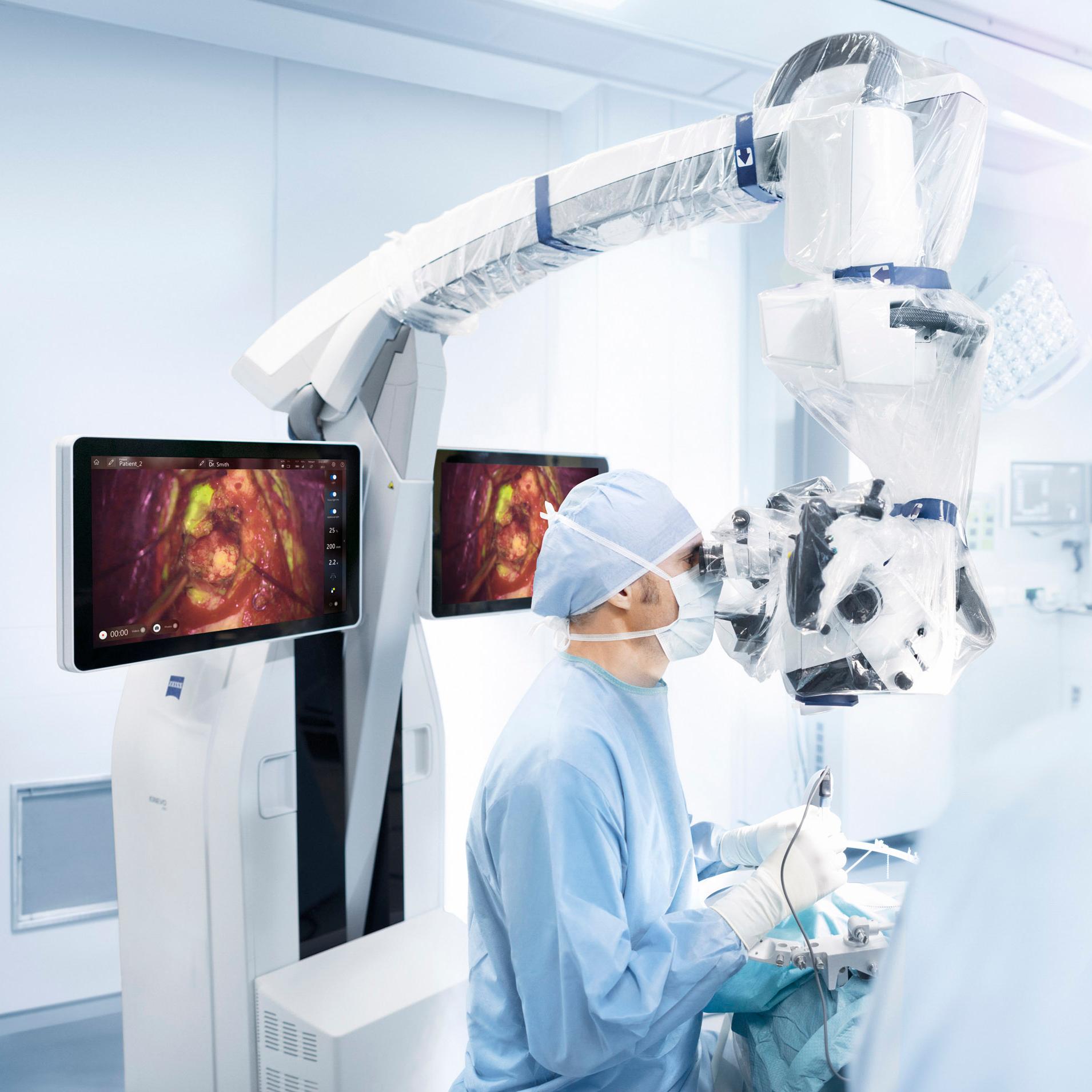
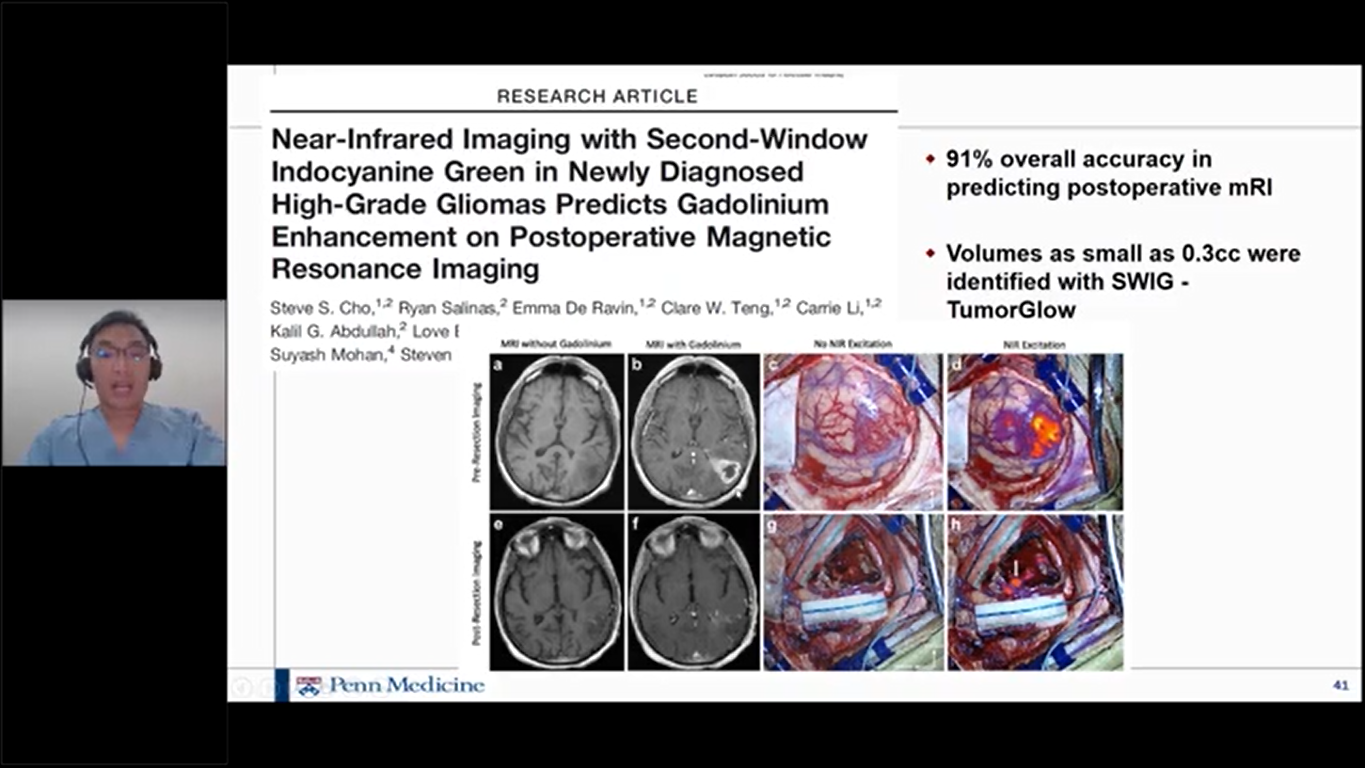
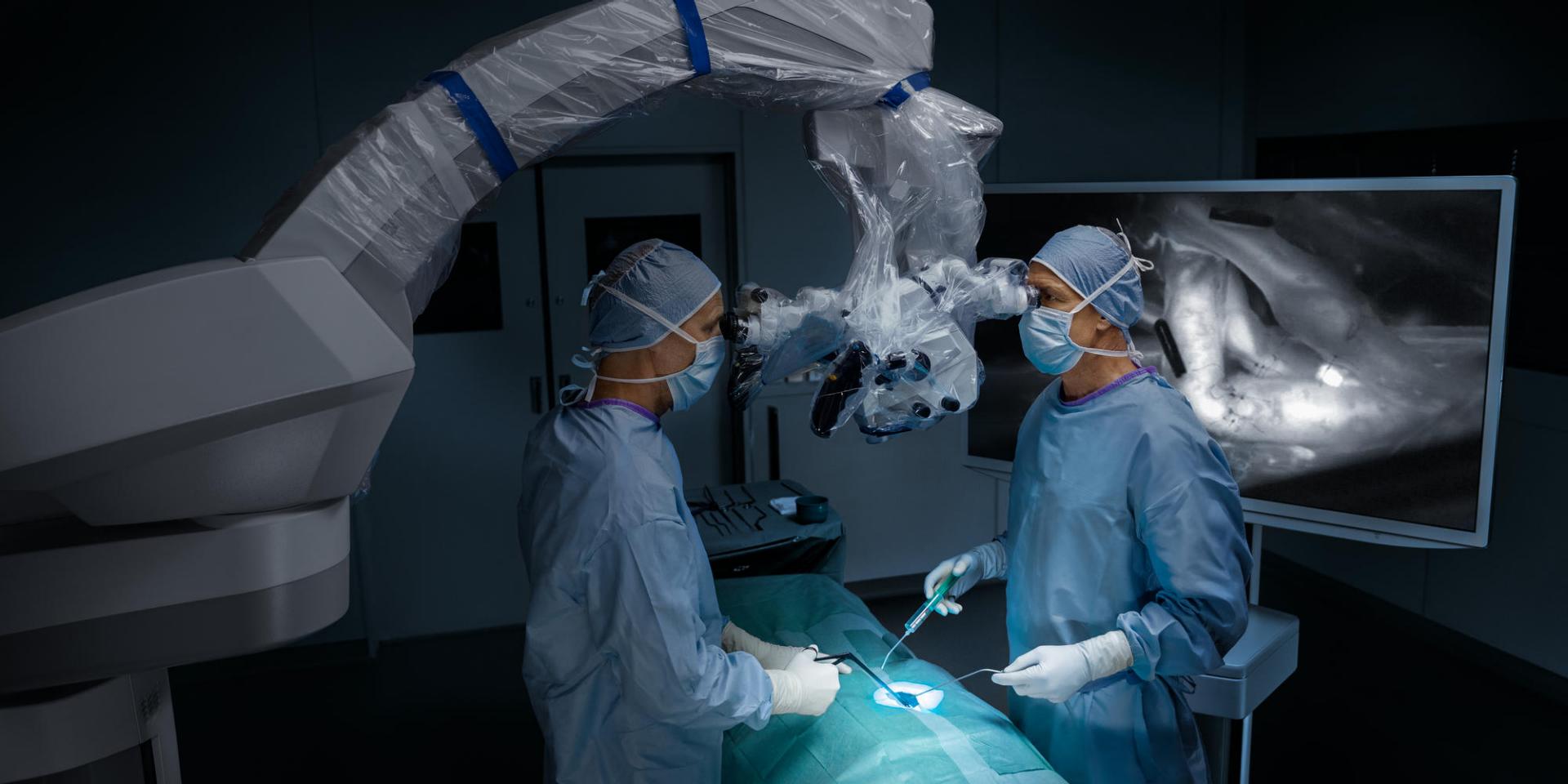
Fluorescence is the property of atoms and molecules, so called fluorophores, to absorb light at a particular wavelength and to subsequently emit light of longer wavelength. Fluorescence microscopy can be based on autofluorescence or the addition of fluorescent dyes.1,2 Under normal light fluorescent dyes might be invisible. But a surgical microscope with integrated fluorescence technology lights up the dye to visualize high-grade glioma tissue or blood vessels during surgery.
The first use of intraoperative fluorescence imaging in surgery dates back to 1948 when surgeons used intravenous fluorescein to enhance intracranial neoplasms during neurosurgery.2,9 Since then, additional fluorescent agents have been used for a variety of surgical applications.4,5,6,9 Intraoperative fluorescence imaging offers the benefits of high contrast and sensitivity, absence of ionizing radiation, ease of use, safety, and high specificity.7,8,9 Moreover, improved visualization can reduce damage to important normal structures such as nerves, blood vessels, ureters, and bile ducts.9
In challenging microsurgery, surgical visualization adjuncts are essential for making the right decisions at the right time. The Intraoperative Fluorescence Technologies1 from ZEISS offer you the tools you need.
Intraoperative visualization of fluorescence-stained structures
Intraoperative visualization of fluorescence-stained structures
Third-party Content Blocked
The video player is blocked due to your cookie preferences. To change the settings and play the video, please click the button below and consent to use of "Functional" tracking technologies.
BLUE 400 from ZEISS
BLUE 400 from ZEISS supports intraoperative differentiation between high-grade glioma cells and healthy tissue in suspected high-grade gliomas (grade III and IV). It was the only microscope integrated fluorescence module to prove its efficiency in a successfully conducted Phase III multi-center study.2
According to a 2015 study by Esteves et al., high-grade gliomas (grades III–IV) are the most common brain tumors in Europe, with an incidence of 3.13 per 100,000 residents. The extent of tumor resection is a major prognostic factor for survival.3 Studies show that resection of at least 98% of the tumor tissue is required to significantly impact the survival rate. A randomized controlled trial (RCT) study by Stummer et al. in 2006 showed that the probability of complete resection of the tumor was significantly increased when using 5-ALA fluorescence (5-aminolevulinic acid) (65% vs. 37%, p<0.0001).2
We [...] published a medical economic study [...] to demonstrate that [by] using BLUE 400, we can improve outcome of the patients [...].
Third-party Content Blocked
The video player is blocked due to your cookie preferences. To change the settings and play the video, please click the button below and consent to use of "Functional" tracking technologies.
Prof. Dr. Andreas Raabe
Director and Head of the Department for Neurosurgery, Inselspital Bern, Switzerland
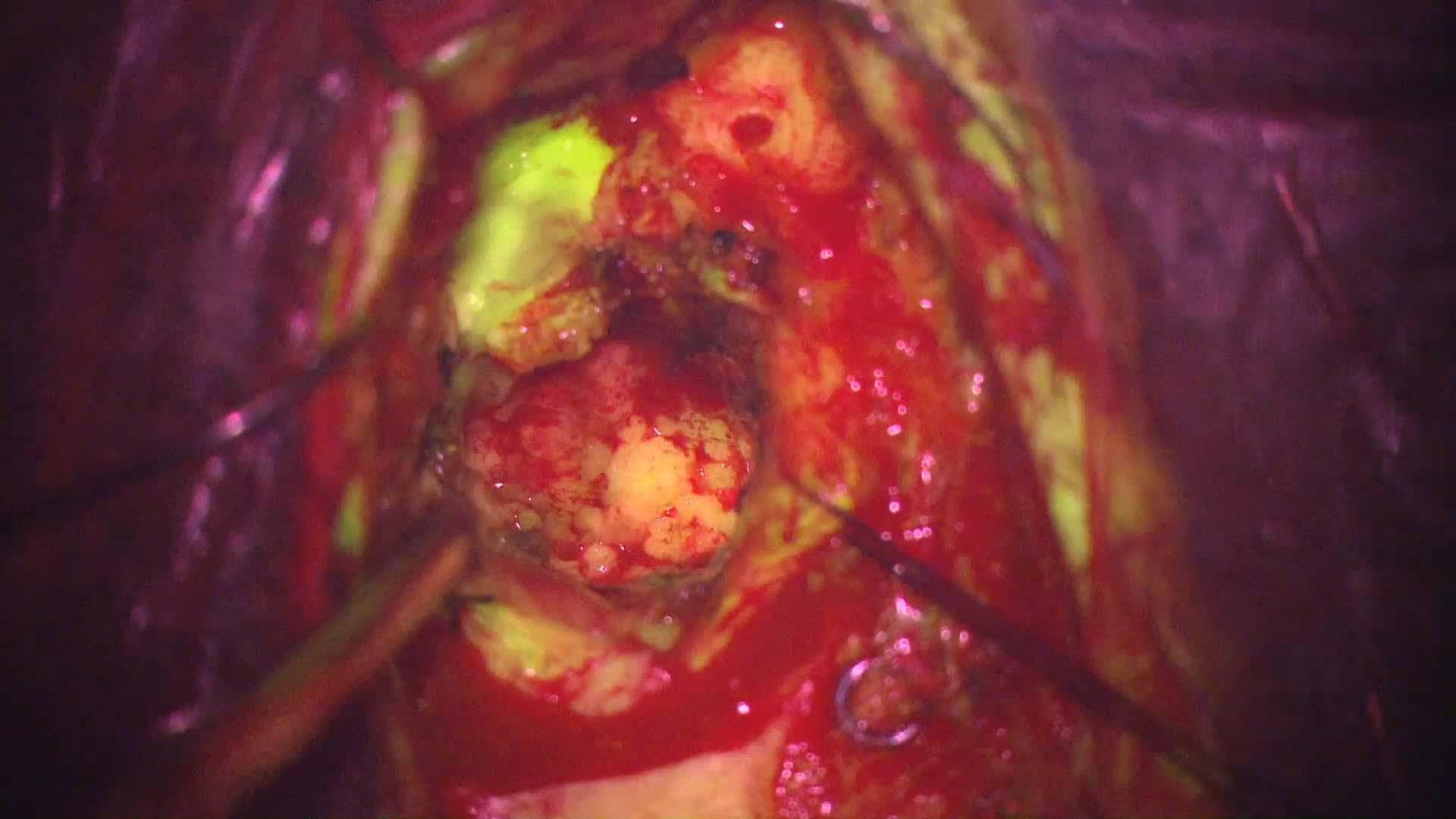
Visualization of fluorescence-stained structures using YELLOW 560. Obtained within the scope of a clinical investigation.
YELLOW 560 from ZEISS
ZEISS YELLOW 56020 is the first intraoperative fluorescence module highlighting green-yellowish fluorescence-stained structures while leaving non-stained tissue in its natural-like color.
Please use the fluorescent agent as per the approval status for the application in your country.
2
Stummer W, Pichlmeier U, Meinel T et al: Fluorescence-guided surgery for resection of malignant glioma: a randomized controlled multicentre phase III trial. In: Lancet Oncol 7: 392-401, 2006.
3
Esteves S, Alves M, Castel-Branco M, Stummer W: A Pilot Cost-Effectiveeness Analysis of Treatments in Newly Diagnoes High-Grade Gliomas: The Example of 5-Aminoelvulinic Acid Compared With White-Light Surgery. In: Neurosurgery 76: 552–562, 2015.
4
Acerb Fi, Cavallo C, Schebesch KM, et al.: Fluorescein-Guided Resection of Intramedullary Spinal Cord Tumors: Results from a Preliminary, Multicentric, Retrospective Study. In: World Neurosurgery 108: 603-609, 2017.
5
Rey-Dios R, Cohen-Gadol AA: Technical principles and neurosurgical applications of fluorescein fluorescence using a microscope-integrated fluorescence module. In: Acta Neurochirurgica 155(4):701–706, 2013.
6
De Laurentis C, Höhne J, Cavallo C, et al.: The impact of fluorescein-guided technique in the surgical removal of CNS tumors in a pediatric population: results from a multicentric observational study. In: Journal of Neurosurgical Sciences 63(6): 679-687, 2019.
7
Acerbi F, Broggi M, Schebesch KM, et al. Fluorescein-guided surgery for resection of high-grade gliomas: A multicentric prospective phase II study (FLUOGLIO). In: Clinical Cancer Research 24(1): 52-61, 2018.
8
Schebesch KM, Proescholdt M, Höhne J, et al.: Sodium fluorescein-guided rescetion under the YELLOW 560 nm surgical microscope filter in malignant brain tumor surgery – a feasibility study. In: Acta Neurochirurgica 157(6): 899–904, 2015.
9
Höhne J, Hohenberger C, Proescholdt M, et al. Fluorescein sodium-guided resection of cerebral metastases-an update. In: Acta Neurochirurgica 159: 363-367, 2017.
10
Raabe A, Beck J, Gerlach R, Zimmermann M, Seifert V: Near-Infrared Indocyanine Green Video Angiography: A New Method For Intraoperative Assessment Of Vascular Flow. In: Neurosurgery 52(1):132-139, 2003.
11
Raabe A, Beck J, Seifert V: Technique and image quality of intraoperative indocyanine green angiography during aneurysm surgery using surgical microscope integrated near-infrared video technology. In: Zentralbl Neurochir 66(1):1–6, 2005.
12
Kamp MA, Slotty P, Turowski B, Etminan N, Steiger HJ, Hänggi D, Stummer W: Microscope-integrated quantitative analysis of intraoperative indocyanine green fluorescence angiography for blood flow assessment: first experience in 30 patients. In: Operative Neurosurgery 70(1 Suppl Operative): 65-73, 2012.
13
Mücke T, Reeps C, Wolff KD, et al.: Objective qualitative and quantitative assessment of blood flow with near-infrared angiography in microvascular anastomoses in the rat model. In: Microsurgery 33(4):287-96, 2013.
14
Ye X, Liu XJ, Ma L, et al.: Clinical values of intraoperative indocyanine green fluorescence video angiography with Flow 800 software in cerebrovascular surgery. In: Chinese Medical Journal 126(22): 4232-4237, 2013.
15
Holling M, Brokinkel B, Ewelt C, et al.: Dynamic ICG fluorescence provides better intraoperative understanding of arteriovenous fistulae. In: Operative Neurosurgery 73(Issue suool_1): 93-99, 2013.
16
Ng YP, King NK, Wan KR, et al.: Uses and limitations of indocyanine green videoangiography for flow analysis in arteriovenous malformation surgery. In: Journal of Clinical Neuroscience 20(2): 224-232, 2013.
17
Holzbach T, Artunian N, Spanholtz TA, et al.: Intraoperative Indocyaningrün-Fluoreszenzdiagnostik mittels Operationsmikroskop in der plastischen Chirurgie. In: Handchirurgie, Plastische Chirurgie, Ästhetische Chirurgie 44(2):84-8, 2012.
18
Mücke T, Fichter AM, Schmidt LH, et al.: Indocyanine green videoangiography-assisted prediction of flap necrosis in the rat epigastric flap using FLOW® 800 Tool. In: Microsurgery 37:235–242, 2017.
19
Stage image: left-temporal craniatomy for tumor resection with YELLOW 560 (clinical investigation - application not cleared for USA). Image courtesy of Dr. Peter Nakaji, Barrow Neurological Institute, Phoenix Arizona, USA
20
Cleared as a class II device for the visualization of blood flow in combination with qualified surgical microscopes.
Intraoperative imaging of cerebral blood flow in vascular surgery
Intraoperative imaging of cerebral blood flow in vascular surgery
Third-party Content Blocked
The video player is blocked due to your cookie preferences. To change the settings and play the video, please click the button below and consent to use of "Functional" tracking technologies.
Hemmorrhage from right temporal AVM. Image courtesy of Dr. Gary K. Steinberg, MD PhD, Stanford University
ZEISS INFRARED 800
With ZEISS INFRARED 800 it is possible to visualize submillimeter blood vessels. Intraoperative imaging of cerebral blood flow is of particular interest in vascular neurosurgery. Fluorescence-assisted angiography using indocyanine green (ICG) allows for real-time qualitative assessment of vascular permeability or pathological vascular structures during surgery. As early as 2003, the results of a feasibility study by Raabe et al. revealed that ICG fluorescence angiography is useful in the assessment of aneurysms.10 Integrated into the surgical microscope, ICG angiography is a suitable technique for visualization and for assisting in the evaluation and interpretation of intraoperative blood flow in vessels with less than 1 mm in diameter. It assists in early detection of complications as well as reducing the risk of ischemic damage and the need for further postoperative intervention.11
INFRARED 800 has changed vascular neurosurgical practice in the OR. It has enabled us to really answer the critical questions after clipping or after a bypass [...]. It has facilitated our operations, shortened the operations, and almost taken away the need for intraoperative angiography.
Third-party Content Blocked
The video player is blocked due to your cookie preferences. To change the settings and play the video, please click the button below and consent to use of "Functional" tracking technologies.
ZEISS FLOW 800
Using ZEISS INFRARED 800 video sequences, the ZEISS FLOW 800 option offers a unique fluorescence application for the visual analysis of vascular blood flow. The information from the video sequences is compiled into visual maps, diagrams, or side-by-side images. This enables a detailed analysis of the fluorescence videos.
Simple imaging of vascular structures is often insufficient for the detection of hypo- or hyperperfusion; doing so requires quantitative analysis of the data.12 Study results have shown that FLOW 800 analysis software provides valuable additional information for surgeons in intraoperative assessment of arterial patency and regional blood flow.13-16
FLOW 800 is an important visualization analysis tool in AVM surgery because it helps us very rapidly to understand the hemodynamics behind an AVM. I've been working with FLOW 800 for several years now [...], I think it became indespensible.
1
Please use the fluorescent agent as per the approval status for the application in your country.
2
Stummer W, Pichlmeier U, Meinel T et al: Fluorescence-guided surgery for resection of malignant glioma: a randomized controlled multicentre phase III trial. In: Lancet Oncol 7: 392-401, 2006.
3
Esteves S, Alves M, Castel-Branco M, Stummer W: A Pilot Cost-Effectiveeness Analysis of Treatments in Newly Diagnoes High-Grade Gliomas: The Example of 5-Aminoelvulinic Acid Compared With White-Light Surgery. In: Neurosurgery 76: 552–562, 2015.
4
Acerb Fi, Cavallo C, Schebesch KM, et al.: Fluorescein-Guided Resection of Intramedullary Spinal Cord Tumors: Results from a Preliminary, Multicentric, Retrospective Study. In: World Neurosurgery 108: 603-609, 2017.
5
Rey-Dios R, Cohen-Gadol AA: Technical principles and neurosurgical applications of fluorescein fluorescence using a microscope-integrated fluorescence module. In: Acta Neurochirurgica 155(4):701–706, 2013.
6
De Laurentis C, Höhne J, Cavallo C, et al.: The impact of fluorescein-guided technique in the surgical removal of CNS tumors in a pediatric population: results from a multicentric observational study. In: Journal of Neurosurgical Sciences 63(6): 679-687, 2019.
7
Acerbi F, Broggi M, Schebesch KM, et al. Fluorescein-guided surgery for resection of high-grade gliomas: A multicentric prospective phase II study (FLUOGLIO). In: Clinical Cancer Research 24(1): 52-61, 2018.
8
Schebesch KM, Proescholdt M, Höhne J, et al.: Sodium fluorescein-guided rescetion under the YELLOW 560 nm surgical microscope filter in malignant brain tumor surgery – a feasibility study. In: Acta Neurochirurgica 157(6): 899–904, 2015.
9
Höhne J, Hohenberger C, Proescholdt M, et al. Fluorescein sodium-guided resection of cerebral metastases-an update. In: Acta Neurochirurgica 159: 363-367, 2017.
10
Raabe A, Beck J, Gerlach R, Zimmermann M, Seifert V: Near-Infrared Indocyanine Green Video Angiography: A New Method For Intraoperative Assessment Of Vascular Flow. In: Neurosurgery 52(1):132-139, 2003.
11
Raabe A, Beck J, Seifert V: Technique and image quality of intraoperative indocyanine green angiography during aneurysm surgery using surgical microscope integrated near-infrared video technology. In: Zentralbl Neurochir 66(1):1–6, 2005.
12
Kamp MA, Slotty P, Turowski B, Etminan N, Steiger HJ, Hänggi D, Stummer W: Microscope-integrated quantitative analysis of intraoperative indocyanine green fluorescence angiography for blood flow assessment: first experience in 30 patients. In: Operative Neurosurgery 70(1 Suppl Operative): 65-73, 2012.
13
Mücke T, Reeps C, Wolff KD, et al.: Objective qualitative and quantitative assessment of blood flow with near-infrared angiography in microvascular anastomoses in the rat model. In: Microsurgery 33(4):287-96, 2013.
14
Ye X, Liu XJ, Ma L, et al.: Clinical values of intraoperative indocyanine green fluorescence video angiography with Flow 800 software in cerebrovascular surgery. In: Chinese Medical Journal 126(22): 4232-4237, 2013.
15
Holling M, Brokinkel B, Ewelt C, et al.: Dynamic ICG fluorescence provides better intraoperative understanding of arteriovenous fistulae. In: Operative Neurosurgery 73(Issue suool_1): 93-99, 2013.
16
Ng YP, King NK, Wan KR, et al.: Uses and limitations of indocyanine green videoangiography for flow analysis in arteriovenous malformation surgery. In: Journal of Clinical Neuroscience 20(2): 224-232, 2013.
17
Holzbach T, Artunian N, Spanholtz TA, et al.: Intraoperative Indocyaningrün-Fluoreszenzdiagnostik mittels Operationsmikroskop in der plastischen Chirurgie. In: Handchirurgie, Plastische Chirurgie, Ästhetische Chirurgie 44(2):84-8, 2012.
18
Mücke T, Fichter AM, Schmidt LH, et al.: Indocyanine green videoangiography-assisted prediction of flap necrosis in the rat epigastric flap using FLOW® 800 Tool. In: Microsurgery 37:235–242, 2017.
19
Stage image: left-temporal craniatomy for tumor resection with YELLOW 560 (clinical investigation - application not cleared for USA). Image courtesy of Dr. Peter Nakaji, Barrow Neurological Institute, Phoenix Arizona, USA
Intraoperative fluorescence imaging in reconstructive surgery
Intraoperative fluorescence imaging in reconstructive surgery
Third-party Content Blocked
The video player is blocked due to your cookie preferences. To change the settings and play the video, please click the button below and consent to use of "Functional" tracking technologies.
Example video showing the use of INFRARED 800 in examining a lymphovenous anastomosis. Courtesy of PD Dr. Christian Taeger, Leading and Senior Physician for the Department of Plastic, Hand and Reconstructive Surgery, University Hospital Regensburg, Germany.
ZEISS INFRARED 800
Typically used in free flap surgery, INFRARED 800 from ZEISS enables fluorescence-assisted assessment of blood flow after an anastomosis has been created and visualizes the vascular patency of the grafted tissue.
A 2012 study by Holzbach et al.17 demonstrates that ICG fluorescence angiography is a useful, expeditious, and safe procedure in flap surgery, especially in intraoperative use. The findings of Mücke et al. show that FLOW 800 constitutes a reliable analysis tool for intraoperative flap perfusion monitoring.18
The integration of fluorescence technology into the surgical microscope offers the surgeon more safety and certainty in clinically ambiguous situations while carrying out the procedure. Blood flow anomalies can be quickly detected, and the required surgical interventions initiated immediately. The method can more successfully predict the complication-free healing of skin and tissue grafts and provide initial indications of thrombosis.
Third-party Content Blocked
The video player is blocked due to your cookie preferences. To change the settings and play the video, please click the button below and consent to use of "Functional" tracking technologies.
Courtesy of Prof. Dr. Milomir Ninkovic, Head of the Department of Plastic & Reconstructive, Hand and Burn Surgery, University Clinic Bogenhausen.
Example video showing the use of INFRARED 800 in checking blood flow after anastomosis.
1
Please use the fluorescent agent as per the approval status for the application in your country.
2
Stummer W, Pichlmeier U, Meinel T et al: Fluorescence-guided surgery for resection of malignant glioma: a randomized controlled multicentre phase III trial. In: Lancet Oncol 7: 392-401, 2006.
3
Esteves S, Alves M, Castel-Branco M, Stummer W: A Pilot Cost-Effectiveeness Analysis of Treatments in Newly Diagnoes High-Grade Gliomas: The Example of 5-Aminoelvulinic Acid Compared With White-Light Surgery. In: Neurosurgery 76: 552–562, 2015.
4
Acerb Fi, Cavallo C, Schebesch KM, et al.: Fluorescein-Guided Resection of Intramedullary Spinal Cord Tumors: Results from a Preliminary, Multicentric, Retrospective Study. In: World Neurosurgery 108: 603-609, 2017.
5
Rey-Dios R, Cohen-Gadol AA: Technical principles and neurosurgical applications of fluorescein fluorescence using a microscope-integrated fluorescence module. In: Acta Neurochirurgica 155(4):701–706, 2013.
6
De Laurentis C, Höhne J, Cavallo C, et al.: The impact of fluorescein-guided technique in the surgical removal of CNS tumors in a pediatric population: results from a multicentric observational study. In: Journal of Neurosurgical Sciences 63(6): 679-687, 2019.
7
Acerbi F, Broggi M, Schebesch KM, et al. Fluorescein-guided surgery for resection of high-grade gliomas: A multicentric prospective phase II study (FLUOGLIO). In: Clinical Cancer Research 24(1): 52-61, 2018.
8
Schebesch KM, Proescholdt M, Höhne J, et al.: Sodium fluorescein-guided rescetion under the YELLOW 560 nm surgical microscope filter in malignant brain tumor surgery – a feasibility study. In: Acta Neurochirurgica 157(6): 899–904, 2015.
9
Höhne J, Hohenberger C, Proescholdt M, et al. Fluorescein sodium-guided resection of cerebral metastases-an update. In: Acta Neurochirurgica 159: 363-367, 2017.
10
Raabe A, Beck J, Gerlach R, Zimmermann M, Seifert V: Near-Infrared Indocyanine Green Video Angiography: A New Method For Intraoperative Assessment Of Vascular Flow. In: Neurosurgery 52(1):132-139, 2003.
11
Raabe A, Beck J, Seifert V: Technique and image quality of intraoperative indocyanine green angiography during aneurysm surgery using surgical microscope integrated near-infrared video technology. In: Zentralbl Neurochir 66(1):1–6, 2005.
12
Kamp MA, Slotty P, Turowski B, Etminan N, Steiger HJ, Hänggi D, Stummer W: Microscope-integrated quantitative analysis of intraoperative indocyanine green fluorescence angiography for blood flow assessment: first experience in 30 patients. In: Operative Neurosurgery 70(1 Suppl Operative): 65-73, 2012.
13
Mücke T, Reeps C, Wolff KD, et al.: Objective qualitative and quantitative assessment of blood flow with near-infrared angiography in microvascular anastomoses in the rat model. In: Microsurgery 33(4):287-96, 2013.
14
Ye X, Liu XJ, Ma L, et al.: Clinical values of intraoperative indocyanine green fluorescence video angiography with Flow 800 software in cerebrovascular surgery. In: Chinese Medical Journal 126(22): 4232-4237, 2013.
15
Holling M, Brokinkel B, Ewelt C, et al.: Dynamic ICG fluorescence provides better intraoperative understanding of arteriovenous fistulae. In: Operative Neurosurgery 73(Issue suool_1): 93-99, 2013.
16
Ng YP, King NK, Wan KR, et al.: Uses and limitations of indocyanine green videoangiography for flow analysis in arteriovenous malformation surgery. In: Journal of Clinical Neuroscience 20(2): 224-232, 2013.
17
Holzbach T, Artunian N, Spanholtz TA, et al.: Intraoperative Indocyaningrün-Fluoreszenzdiagnostik mittels Operationsmikroskop in der plastischen Chirurgie. In: Handchirurgie, Plastische Chirurgie, Ästhetische Chirurgie 44(2):84-8, 2012.
18
Mücke T, Fichter AM, Schmidt LH, et al.: Indocyanine green videoangiography-assisted prediction of flap necrosis in the rat epigastric flap using FLOW® 800 Tool. In: Microsurgery 37:235–242, 2017.
19
Stage image: left-temporal craniatomy for tumor resection with YELLOW 560 (clinical investigation - application not cleared for USA). Image courtesy of Dr. Peter Nakaji, Barrow Neurological Institute, Phoenix Arizona, USA
Get in touch with us!
Receive more information about the product and availability in your country!
1
Please use the fluorescent agent as per the approval status for the application in your country. This product is availably for US customers only.
2
Stummer W, Pichlmeier U, Meinel T et al: Fluorescence-guided surgery for resection of malignant glioma: a randomized controlled multicentre phase III trial. In: Lancet Oncol 7: 392-401, 2006.
3
Esteves S, Alves M, Castel-Branco M, Stummer W: A Pilot Cost-Effectiveeness Analysis of Treatments in Newly Diagnoes High-Grade Gliomas: The Example of 5-Aminoelvulinic Acid Compared With White-Light Surgery. In: Neurosurgery 76: 552–562, 2015.
4
Acerb Fi, Cavallo C, Schebesch KM, et al.: Fluorescein-Guided Resection of Intramedullary Spinal Cord Tumors: Results from a Preliminary, Multicentric, Retrospective Study. In: World Neurosurgery 108: 603-609, 2017.
5
Rey-Dios R, Cohen-Gadol AA: Technical principles and neurosurgical applications of fluorescein fluorescence using a microscope-integrated fluorescence module. In: Acta Neurochirurgica 155(4):701–706, 2013.
6
De Laurentis C, Höhne J, Cavallo C, et al.: The impact of fluorescein-guided technique in the surgical removal of CNS tumors in a pediatric population: results from a multicentric observational study. In: Journal of Neurosurgical Sciences 63(6): 679-687, 2019.
7
Acerbi F, Broggi M, Schebesch KM, et al. Fluorescein-guided surgery for resection of high-grade gliomas: A multicentric prospective phase II study (FLUOGLIO). In: Clinical Cancer Research 24(1): 52-61, 2018.
8
Schebesch KM, Proescholdt M, Höhne J, et al.: Sodium fluorescein-guided rescetion under the YELLOW 560 nm surgical microscope filter in malignant brain tumor surgery – a feasibility study. In: Acta Neurochirurgica 157(6): 899–904, 2015.
9
Höhne J, Hohenberger C, Proescholdt M, et al. Fluorescein sodium-guided resection of cerebral metastases-an update. In: Acta Neurochirurgica 159: 363-367, 2017.
10
Raabe A, Beck J, Gerlach R, Zimmermann M, Seifert V: Near-Infrared Indocyanine Green Video Angiography: A New Method For Intraoperative Assessment Of Vascular Flow. In: Neurosurgery 52(1):132-139, 2003.
11
Raabe A, Beck J, Seifert V: Technique and image quality of intraoperative indocyanine green angiography during aneurysm surgery using surgical microscope integrated near-infrared video technology. In: Zentralbl Neurochir 66(1):1–6, 2005.
12
Kamp MA, Slotty P, Turowski B, Etminan N, Steiger HJ, Hänggi D, Stummer W: Microscope-integrated quantitative analysis of intraoperative indocyanine green fluorescence angiography for blood flow assessment: first experience in 30 patients. In: Operative Neurosurgery 70(1 Suppl Operative): 65-73, 2012.
13
Mücke T, Reeps C, Wolff KD, et al.: Objective qualitative and quantitative assessment of blood flow with near-infrared angiography in microvascular anastomoses in the rat model. In: Microsurgery 33(4):287-96, 2013.
14
Ye X, Liu XJ, Ma L, et al.: Clinical values of intraoperative indocyanine green fluorescence video angiography with Flow 800 software in cerebrovascular surgery. In: Chinese Medical Journal 126(22): 4232-4237, 2013.
15
Holling M, Brokinkel B, Ewelt C, et al.: Dynamic ICG fluorescence provides better intraoperative understanding of arteriovenous fistulae. In: Operative Neurosurgery 73(Issue suool_1): 93-99, 2013.
16
Ng YP, King NK, Wan KR, et al.: Uses and limitations of indocyanine green videoangiography for flow analysis in arteriovenous malformation surgery. In: Journal of Clinical Neuroscience 20(2): 224-232, 2013.
17
Holzbach T, Artunian N, Spanholtz TA, et al.: Intraoperative Indocyaningrün-Fluoreszenzdiagnostik mittels Operationsmikroskop in der plastischen Chirurgie. In: Handchirurgie, Plastische Chirurgie, Ästhetische Chirurgie 44(2):84-8, 2012.
18
Mücke T, Fichter AM, Schmidt LH, et al.: Indocyanine green videoangiography-assisted prediction of flap necrosis in the rat epigastric flap using FLOW® 800 Tool. In: Microsurgery 37:235–242, 2017.
19
Stage image: left-temporal craniatomy for tumor resection with YELLOW 560 (clinical investigation - application not cleared for USA). Image courtesy of Dr. Peter Nakaji, Barrow Neurological Institute, Phoenix Arizona, USA
20
Cleared as a class II device for the visualization of blood flow in combination with qualified surgical microscopes.