Multiphotonic microscopy enable 7 color spectral imaging with one shot wavelength excitation


Introduction
Multiphoton microscopy is a form of nonlinear microscopy that relies on the simultaneous absorption of multiple low-energy photons (e.g., two or more) to excite a molecule. This technique has several advantages over conventional single-photon microscopy, including
Deeper excitation: due to the nature of, Infra-Red Light used in microscopy, is less scattered by samples allowing deeper penetration of the light into samples, particularly in thick tissues such as living organs,
Less photodamage and phototoxicity than visible LSM: as excitation is confined to the focal volume of the light beam. Moreover, the lower energy of the photons used results in reduced radiation exposure along the excitation path within the tissue compared to conventional visible-light microscopy. Another advantage of multiphoton microscopy is access to harmonic generation microscopy. Second harmonic generation (SHG) and third harmonic generation (THG) do not require external labeling, as they occur naturally in certain structures in biological tissues. These processes are exploited in multiphoton microscopy to visualize certain structural components (collagen, lipids).
The development and improvement of multicolor imaging technologies allow researchers to explore the complexity of the cellular composition of biological tissues, as accessible by cytometry techniques, while preserving information on the spatial organization of these tissues. Thus, these techniques offer information on the localization of cells of interest as well as spatial organization of cells within the tissue. Among these advanced techniques, modern microscopes equipped with multispectral imaging and linear unmixing are capable of simultaneously separating more than five fluorochromes, even when their emission spectra overlap, depending on the number of laser sources present in these systems [1]. Multispectral multiphoton microscopy is possible, but it traditionally requires multiple excitation wavelengths or complex pulse-synchronization schemes, which introduce significant optical alignment challenges and chromatic aberrations [2-3]. Moreover, spectral crosstalk and dispersion management complicate simultaneous excitation of several fluorophores, limiting robustness and accessibility of multicolor deep-tissue imaging. Single-wavelength multispectral strategies therefore offer an attractive alternative by simplifying the optical design while enabling stable, low-power excitation of multiple fluorophores [4]. To date, no study has presented a multiphotonic multispectral imaging approach that enables more than 3 fluorochromes separation with a single illumination source. Here we propose a 7-color multispectral imaging strategy allowing the localization of large cellular compartments in adipose tissue using only a biphoton approach and a single wavelength.
Experimental procedure
Biological protocol :
Paraformaldehyde (PFA) (4%) fixed adipose tissue from C57BL6 mice were embedded in agarose 2% overnight and sliced with Vibroslicer® 5100 mz (Campden instruments) (300 µm thick). Samples were simultaneously permeabilized and blocked using 0.2% Triton X-100 and horse serum in PBS. Tissue sections were incubated with fluorochrome coupled antibodies (table1) overnight at room temperature under constant agitation. Several washing with PBS with triton were performed, and then nuclei were stained with Draq5.
Images acquisition :
Images acquisition was performed on a ZEISS LSM880 NLO confocal microscope equipped with a gallium arsenide phosphide (GaAsP) spectral array detector tuning to 8.9 nm that allows 32 channel images ranging from 410 to 695 nm. Emission spectrum for each fluorochrome was extracted to be used in the “online fingerprinting” mode of ZEN Black imaging software. We used a High-Power Widely Tunable Femto second laser from Coherent (Chameleon Discovery NX) tuning range from 610 to 1320 nm to excite the samples.
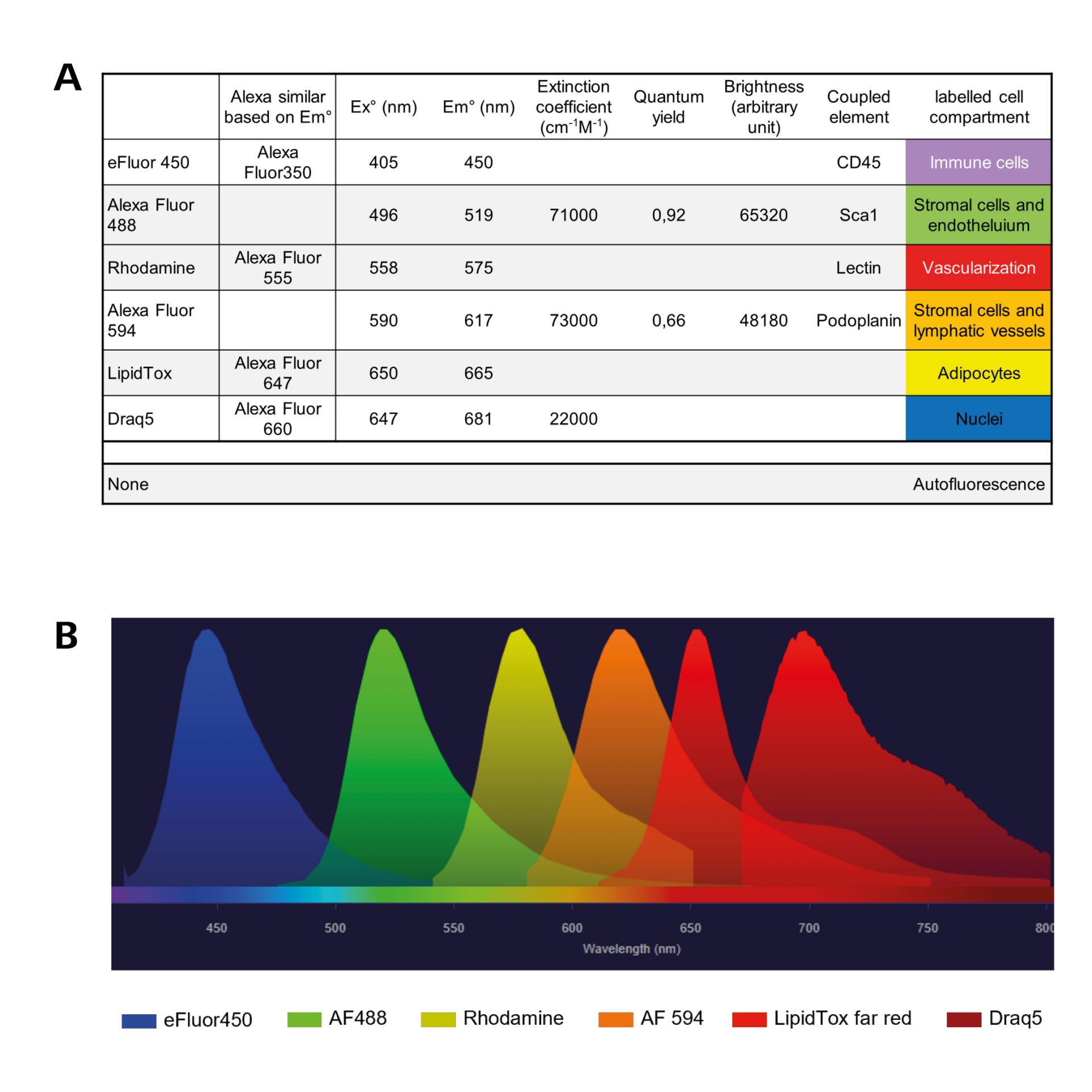


Figure 1 - Characteristics of fluorochromes used for this study
(A) Spectral Properties of the Fluorochromes used, their conjugated targets, and corresponding labeled cell types in the tissues. The color code used corresponds to that applied for representing fluorescence signals in the images , (B) Theoretical fluorescence emission spectra of the selected fluorochromes as generated using the Thermo Fisher Spectral Viewer.
Figure 1 - Characteristics of fluorochromes used for this study
(A) Spectral Properties of the Fluorochromes used, their conjugated targets, and corresponding labeled cell types in the tissues. The color code used corresponds to that applied for representing fluorescence signals in the images , (B) Theoretical fluorescence emission spectra of the selected fluorochromes as generated using the Thermo Fisher Spectral Viewer.
1. Choice of fluorochromes used for multiphotonic acquisition
Figure 1 illustrates spectral properties of the fluorochromes employed in this study [https://app.fluorofinder.com/dyes/], all of which exhibit efficient excitation at 800 nm. This spectral compatibility enables the implementation of multispectral imaging using multiphoton microscopy with a single excitation wavelength. Additional combinations of fluorochromes effectively excited at 800 nm were also evaluated and found to be compatible with multiplexed imaging using a single excitation wavelength (data not shown). Moreover, excitation at 800 nm enables the detection of the second harmonic generation (SHG) signal, thereby allowing label-free imaging of collagen. This panel enables the simultaneous visualization of the main cellular compartments within the studied tissues in a single acquisition, without any spatial or temporal offset.


Figure 2 - Reference emission spectra acquisition
Comparison of experimentally acquired emission spectra using confocal and two-photon microscopy with the corresponding theorical spectra of the fluorochromes. The graphs display normalized spectra spanning the 410 to 690 nm wavelength range.
Figure 2 - Reference emission spectra acquisition
Comparison of experimentally acquired emission spectra using confocal and two-photon microscopy with the corresponding theorical spectra of the fluorochromes. The graphs display normalized spectra spanning the 410 to 690 nm wavelength range.
2. Acquisition of emission spectra references
We recorded the true fluorescence emission spectra in two-photon excitation mode at an excitation wavelength of 800 nm using the "lambda" mode of the ZEN Black software. To this end, we performed single labeling experiments with each antibody or fluorescent probe of interest. In parallel, we also acquired emission spectra using confocal lasers coupled with the appropriate dichroic filters. Figure 2 presents the normalized spectra profiles and highlights the differences between spectra obtained following continuous wave and pulsed excitation. Our results indicate that the two-photon excitation spectra more closely resemble the theoretical spectra retrieved from the Spectral Viewer database. It is largely attributable to the fact that the experimentally measured spectra are not truncated or distorted by the spectral response of dichroic mirrors or other optical filters.


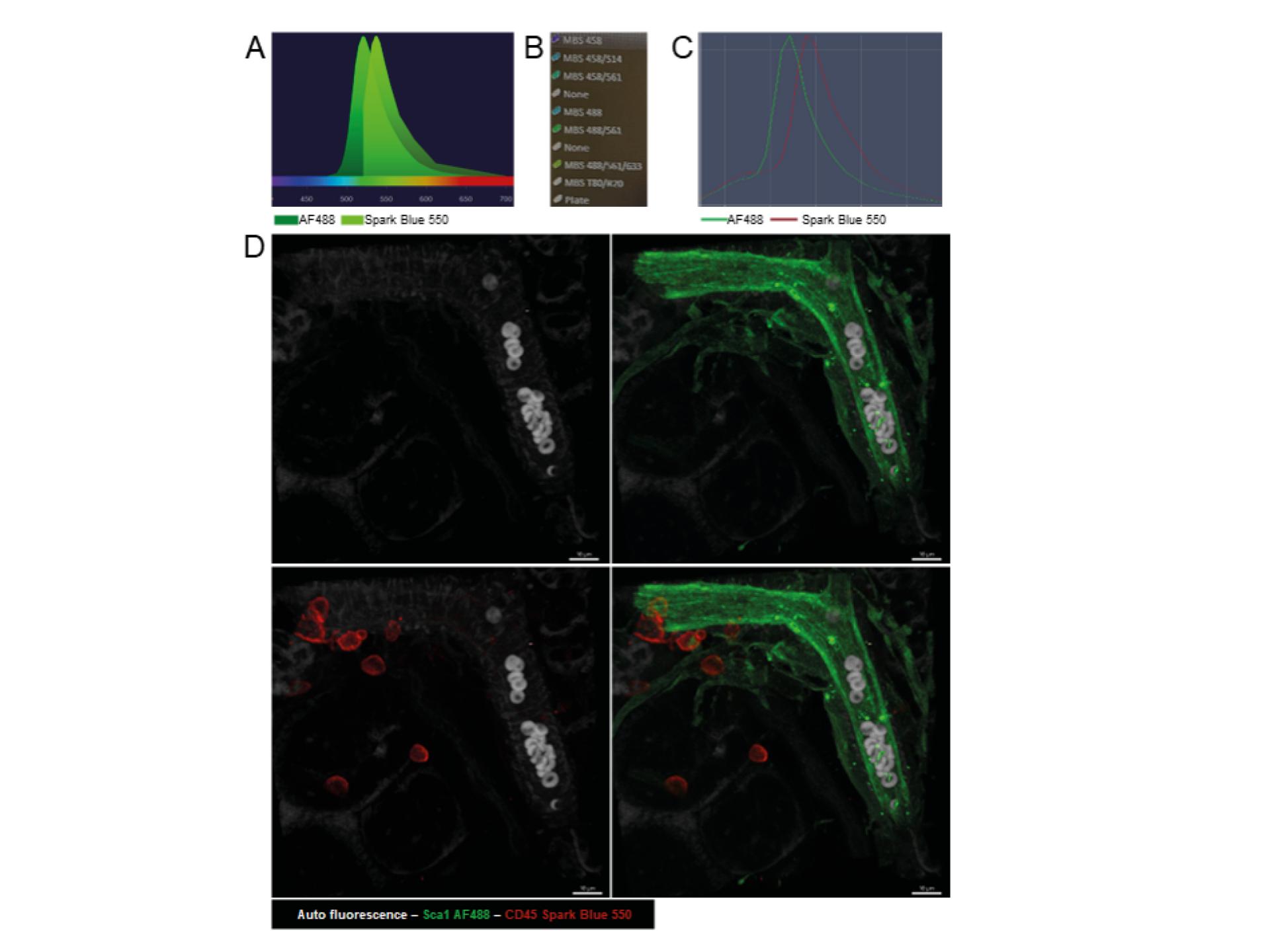

Figure 3 - Single wavelength two photon excitation enable reliable separation of AF488 and Spark Blue 550. (A) Theoretical spectra of fluorochromes, (B) Beam splitter MBS available, (C) Experimentally acquired emission spectra with two-photon laser, (D) Pseudo-color images illustrating efficient Two-Photon Separation of AF488 and Spark Blue 550.
Figure 3 - Single wavelength two photon excitation enable reliable separation of AF488 and Spark Blue 550. (A) Theoretical spectra of fluorochromes, (B) Beam splitter MBS available, (C) Experimentally acquired emission spectra with two-photon laser, (D) Pseudo-color images illustrating efficient Two-Photon Separation of AF488 and Spark Blue 550.
3. Separation of highly overlapping fluorochromes using single-wavelength two-photon excitation
We demonstrate that a single excitation wavelength in multiphoton imaging enables the separation of Alexa Fluor 488 and Spark Blue 550 (whose spectral profile closely resembles that of Alexa Fluor 514).
These two fluorochromes exhibit highly similar emission spectra (Fig. 3A) and are notoriously difficult to separate using confocal microscopy with only a 488 nm excitation. In conventional confocal imaging, effective discrimination typically requires sequential excitation at both 488 nm and 514 nm. However, due to the current microscope configuration, a 488/514 nm dichroic beam splitter does not exist (Fig. 3B), making one-line fingerprinting in a single acquisition impossible. In contrast, both fluorochromes were efficiently excited at 800 nm under two-photon excitation. Using the Lambda acquisition mode, we recorded their actual emission spectra directly within the sample.
A reference spectrum corresponding to tissue autofluorescence was also acquired from an unstained control sample. These spectral references were then used for online fingerprinting, combined with a real-time linear unmixing algorithm, allowing precise visualization of each individual fluorochrome signal. As shown in Figure 3D, a single two-photon excitation is sufficient to clearly separate fluorochromes with closely overlapping emissions in a single scan. No spectral overlap was observed between CD45-positive cells (leukocytes) and mesenchymal or endothelial cells expressing the CD34 surface marker, confirming accurate signal discrimination and robust cell-type identification.


Segmentation des noyaux cellulaires basée sur des méthodes conventionnelles d'analyse d'images


Figure 4 - 7 colors separation using 800 nm biphotonic wave length excitation in mouse adiopose tissue.
(A) Oneline fingers printing images, (B) Image of autofluorescence, (C) Merge images.
Figure 4 - 7 colors separation using 800 nm biphotonic wave length excitation in mouse adiopose tissue.
(A) Oneline fingers printing images, (B) Image of autofluorescence, (C) Merge images.
4. A single track for 7 color separation using only one multiphotonic beam laser excitation
To ensure optimal signal quality and fluorochrome separation, staining conditions had to be carefully optimized. This was necessary for two main reasons. Although both fluorochromes could be excited at the same wavelength, their excitation efficiency varied. Furthermore, the use of a single acquisition track prevented individual adjustment of imaging parameters for each fluorochrome. We used antibodies coupled to fluorochromes illustrated in figure1 to visualize the main cellular compartments in adipose tissue in a single acquisition.
Figure 4A presents each unmixed fluorescence images acquired using a single acquisition track with two-photon excitation at 800 nm. The images display the distinct signals of each fluorochrome following real-time spectral unmixing. Figure 4B shows the merged images combining the spectrally unmixed signals from each fluorochrome. This overlay allows visualization of the spatial distribution and potential interactions between the labeled cell populations, demonstrating the effectiveness of the spectral unmixing and single- wavelength two-photon excitation approach in resolving closely overlapping fluorochromes within complex tissue samples.


Figure 5 - Multispectral image of adipose tissue (left)
Second Harmonic Generation (SGH) alone (right) Merge image (8 colors) visualized on Imaris software.
Figure 5 - Multispectral image of adipose tissue (left)
Second Harmonic Generation (SGH) alone (right) Merge image (8 colors) visualized on Imaris software.
Furthermore, the use of an 800 nm laser beam also enables the Generation of a Second Harmonic signal (SHG) (Figure 5), which provides additional contrast without the need for exogenous labeling. This signal reveals structural information related to the composition and organization of fibrillar collagen within the tissue. As collagen architecture is often altered in various pathological conditions, SHG imaging offers valuable insights into the pathophysiological state of the sample.
Discussion
Simultaneous imaging of multiple fluorescent labels within biological tissues is crucial for dissecting complex cellular and molecular interactions. We have overcome the main challenge: the ability to efficiently excite multiple fluorophores with distinct emission spectra using a single excitation wavelength. Since two-photon excitation is highly wavelength-dependent and nonlinear, identifying a wavelength that provides sufficient excitation efficiency for multiple fluorochromes simultaneously was non-trivial. To achieve this, we chose to use antibodies directly conjugated to fluorochromes. Several fluorescent conjugates were tested to identify those efficiently excited by two-photon microscopy at a single excitation wavelength.Here we propose a multiphotonic imaging approach of multilabel excitation (7 channels) with a unique excitation wavelength. This offers several advantages, including that of eliminating the impact of excitation wavelengths on chromatic aberrations.
In addition to enabling efficient fluorochrome separation, the use of an 800 nm laser also allowed the generation of a second harmonic generation (SHG) signal. This intrinsic signal, which does not require any exogenous labeling, provides complementary structural information, particularly on the organization and composition of fibrillar collagen. Given that collagen architecture is frequently altered in pathological conditions such as fibrosis, inflammation, or tumor progression, SHG imaging adds valuable context to the interpretation of the tissue pathophysiological state. This multimodal approach, combining fluorescence and label-free SHG, enhances the biological relevance of imaging data and supports more comprehensive tissue analysis.
Contrary to regular methods using several excitation wavelengths to acquire up to 7 colors [5], here we have demonstrated the capability to acquire up to seven colors or more using only a single excitation wavelength. This breakthrough opens new possibilities for simplifying laser setups in multiphoton imaging applications. Some infrared (IR) lasers provide a fixed emission line, which allows for the creation of more affordable and robust solutions for multicolor multiphoton imaging. By leveraging this innovation, researchers can utilize simpler laser systems without sacrificing imaging performance.
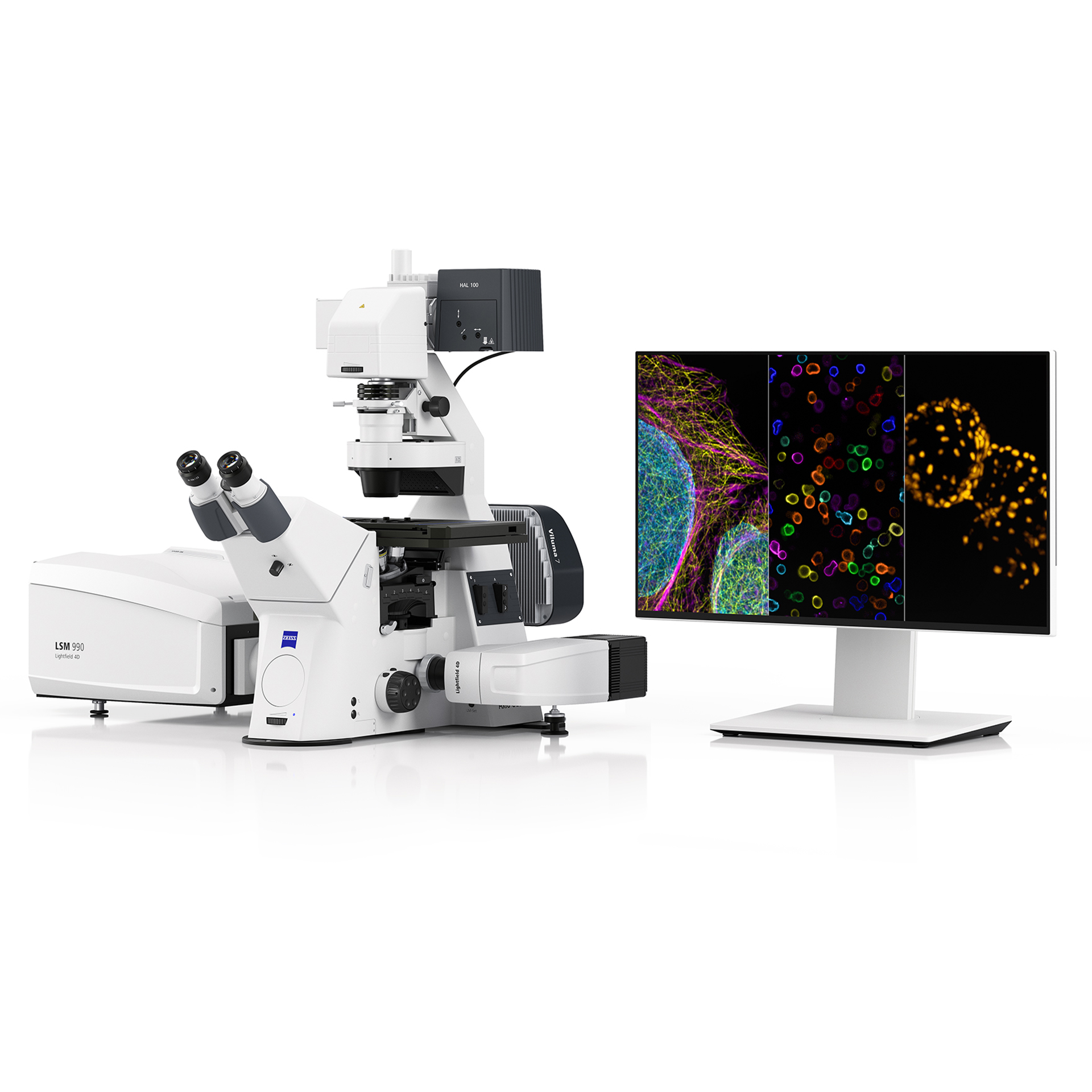
Furthermore, this work was performed on the LSM 880 system, which supports a maximum of eight simultaneously unmixable colors. In contrast, the new LSM 980 NLO and LSM 990 NLO systems are equipped with advanced spectral detection technology and are operated via ZEN Blue software. These platforms allow the use of all available detectors through the online fingerprinting mode, enabling the combination of a greater number of fluorophores within a single scan. As a result, highly multiplexed imaging can be achieved, leading to improved experimental efficiency and enhanced data quality.
About the authors
Corinne Barreau is a university-trained engineer. She joined Restore at its inception in 2021, where she is in charge of the confocal and multiphoton imaging platform facility. She has developed label-free approaches based on second- and third-harmonic generation signals and is an expert in multispectral imaging. Within the Stromagics team, she co-supervises interdisciplinary projects involving multicolor and label-free imaging on 3D samples, as well as deep-learning–based analysis. She created and currently coordinates the “Multiplex” working group within the RT-MFT network of the CNRS MITI.
Jacques Rouquette is a Research Engineer at CNRS. He joined the Restore laboratory in 2021, where he serves as the director of the Restore technological center, which brings together all of the laboratory’s technology platforms. He spearheaded the development of light-sheet microscopy in Toulouse and initiated the partnership between Zeiss and the Restore laboratory.
Coralie Sengenes is a Research Director at Inserm. She has led the Stromagics team at Restore since 2021. Her research focuses on inter-organ communication by stromal cells during muscle repair processes, and on how these mechanisms are affected by aging.
References
[1] Lelouard H, et al. A ten-color spectral imaging strategy to reveal localization of gut immune cell subsets. Application Note, Methods 2018.
[2] Rakhymzhan A, et al. Synergistic Strategy for multicolor Two-photon microscopy: Application to the analysis of germinal center reactions in vivo. Scientific Reports 2017.
[3] Blanc H, et al. Chromatically Corrected Multicolor Multiphoton Microscopy “ACS photonics, vol10/Issue 12, 2023.
[4] Yan W, et al. Multi-color two photon microscopic imaging based on a single wavelength excitation. Biosensors 12 (5) 2022
[5] Duarte D, et al. Inhibition of Endosteal Vascular Niche Remodeling Rescues Hematopoietic Stem Cell Loss in AML. Cell Stem Cell Volume 22, Issue 1, 2018