Boosting scientific efficiency: Institutional licenses transform image processing and data analysis operations
In the heart of Europe, the ETH Zurich in Switzerland hosts a renowned core facility and central technology platform: the Scientific Center for Optical and Electron Microscopy (ScopeM). Dr. Gábor Csúcs, the Technical Manager for Light Microscopy and Histology, passionately champions this facility's mission to support a diverse array of researchers across disciplines such as life sciences, geology, chemistry, and physics, and many other fields.
With an impressive collection of 60 microscopes – half light and half electron – the facility is a hub of innovation. It welcomes around 1,000 active users each year, including 400 new researchers. Dr. Csúcs and his team navigate a complex landscape of challenges daily. The heterogeneous, multivendor setup requires constant attention for maintenance, consultations, and user onboarding to ensure seamless operation and support for the research community.
Navigating the challenges of modern microscopy
As Dr. Csúcs reflects on the evolution of microscopy, he recalls a time when data was manageable, and transferring images was a straightforward task. "Today, our microscopes are faster, and the detectors are larger," he explains, a hint of frustration in his voice. "We generate much more data than we did 10-15 years ago." The challenge? Making sense of this data and ensuring that every researcher can access and utilize it effectively.
One particular hurdle stands out: the variety of microscope image formats. For quite a while, only open source (such as ImageJ) or complex commercial software were able to handle the many proprietary file-formats used in ScopeM. Dr. Csúcs recounts a moment of relief when he discovered that ZEISS ZEN can perform this task easily and effectively, proving to be more robust and user-friendly than its open-source counterparts. Today, he is using the ZEN software to open files also from other vendors’ microscopes and perform basic processing tasks.
Seamless access across multiple workstations
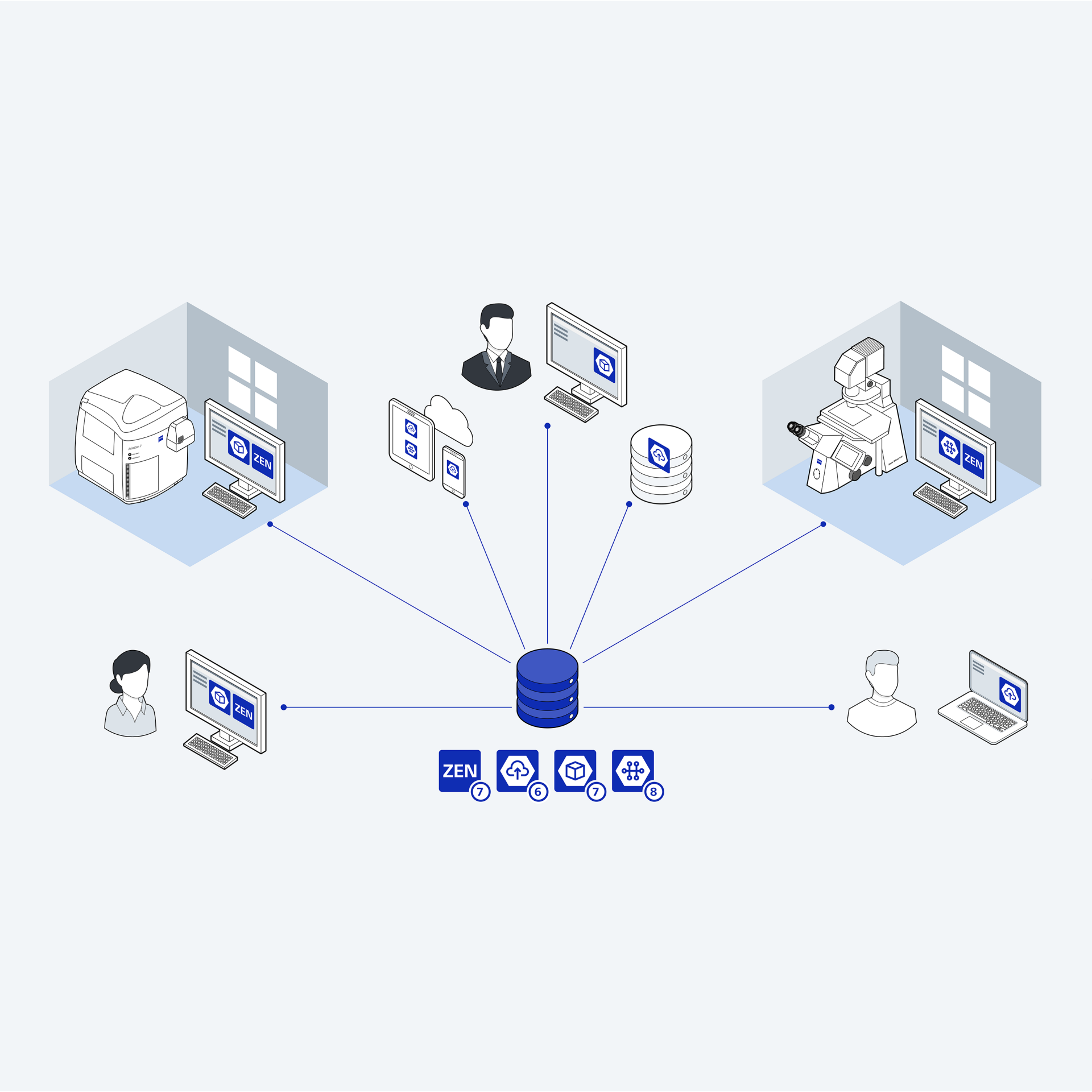
ZEISS Institutional Licenses also transformed the facility's operations. They provide comprehensive access to the entire software suite with all modules. The users can access every toolkit and software piece from ZEISS all at once.
Dr. Csúcs remembers when institutional licenses had not yet been implemented. Each workstation was equipped with a single software license. Different machines could have different versions of the software with different processing modules. This limited the access to ZEN image analysis tools for multiple users at the same time and created a complex environment in which specific processing or analysis options were bound to specific computers.
With ZEISS Institutional Licenses, researchers now also benefit from direct access to the latest versions of all modules. The core facility IT team enjoys simplified license management, including access permissions and updates.
Now, with the ZEISS Institutional Licenses and the virtual machine setup, users can work from their own devices – be it Linux or Mac – without any barriers, even from home.
Embracing flexibility and operational efficiency
The institutional licenses not only resolved access issues but also provided more flexibility. The multi-user access facilitated by floating licenses allows users to access ZEISS software tools from any location, reducing wait times and simplifying administrative maintenance.
The rental model, including virtual set-up, allows the facility to stay current with the latest features: It's easy to stay updated with institutional licenses, which always provide every user with access to the latest software versions.
We no longer face limitations. Whenever someone wants to work with ZEN, they can dive right in. It’s a win-win situation for all of us.
ZEISS Institutional Licenses at ScopeM of ETH Zurich
Third-party Content Blocked
The video player is blocked due to your cookie preferences. To change the settings and play the video, please click the button below and consent to use of "Functional" tracking technologies.
Dr. Csúcs discusses how ZEISS Institutional Licenses have significantly improved operations at the ETH Zurich core facility by providing flexible, multi-user access to essential software tools. This transformation has eliminated previous bottlenecks, ensured constant updates with the latest features, and enhanced overall manageability and cost efficiency.
Floating licenses offer a higher level of flexibility when setting up a subscription. Dr. Csúcs notes that this adaptability allows them to respond to user needs and requests swiftly. "If demand increases, we can easily expand our number of licenses within the existing infrastructure," he says. "It’s all about being agile and responsive."
As Dr. Csúcs reflects on the journey, he realizes that the decision to adopt ZEISS Institutional Licenses has been transformative – he concludes with a sense of accomplishment. The ability to remain up-to-date and adapt to user demands with ease underscores the value of these licenses in supporting the facility's optimized operations and growth.
In terms of manageability, sustainability and cost efficiency, this has certainly been one of the best choices we've ever made.
Bridging research and industry with expert consultation
The facility is not just a place for research; its staff consults industrial and biotech companies on microscopy equipment and workflows. This dynamic environment fosters innovation and endless possibilities. With ZEISS by their side, Dr. Csúcs and his team are ready to tackle the future.
In brief
Institutional licenses streamline operations by providing comprehensive access to essential software tools, allowing researchers to work efficiently from any device and location, and reducing bottlenecks in software usage and maintenance.
Institutional licenses tackle challenges such as diverse data formats and limited software access by offering seamless processing capabilities and flexible multi-user access, ensuring researchers can efficiently utilize data and up-to-date tools.
Institutional licenses offer operational flexibility by enabling easy expansion of software access in response to user demand, simplifying administrative tasks, and ensuring facilities stay current with the latest software updates, thus supporting agile and responsive research environments.