Pioneering Prostate Cancer Research: Studying Membrane Receptors with Widefield Microscopy
The Research Laboratory of the Department of Urology and Pediatric Urology at University Hospital RWTH Aachen in Germany is dedicated to advancing cancer research by optimizing minimally invasive procedures and developing personalized diagnostics and therapies. Their translational research focuses on understanding cancer development, metastasis, and the identification of novel biomarkers.
The Role of Membrane Receptors in Cancer Development
Investigating the localization and intracellular processing of membrane receptors in prostate, bladder, and kidney tumors is at the forefront of translational research. Membrane receptors play a critical role in cellular communication and signaling. These proteins located on the cell surface bind to specific ligands, such as hormones or growth factors.
The focus on the folate receptor 1 (FR1) and prostate-specific membrane antigen (PSMA) as potential biomarkers in prostate cancer is crucial for understanding tumor biology and therapy response. FR1 is involved in cellular uptake of folate, which is essential for DNA synthesis and repair, making it a key player in cancer cell proliferation. PSMA, on the other hand, is highly expressed in prostate cancer cells and is associated with tumor aggressiveness.
By studying these receptors, the urological research team at University Hospital RWTH Aachen gains insights into how prostate cancer cells respond to therapies, allowing for the development of more targeted and effective treatment strategies. Identifying changes in receptor expression or localization can also help in predicting patient outcomes and tailoring personalized therapies.
The Research Laboratory of the Department of Urology and Pediatric Urology at University Hospital RWTH Aachen: Prof. Dr. med. Matthias Saar, Clinical Director; Dr. rer. nat. Marco Hoffmann, Head of Laboratory and Clinical-trial Manager and M.Sc. Sven Gerlach, Scientific Laboratory Assistant (from left)
Insights into Therapy Response and Biomarker Identification
Prof. Dr. med. Matthias Saar (Clinical Director) and Dr. rer. nat. Marco Hoffmann (Head of Laboratory and Clinical-trial Manager) at the Department of Urology and Pediatric Urology, and their team investigate how treatment strategies, such as Androgen receptor blockade, affect PSMA membrane localization and intracellular accumulation – particularly in the endoplasmic reticulum (ER), and how these changes correlate with ER stress marker expression.
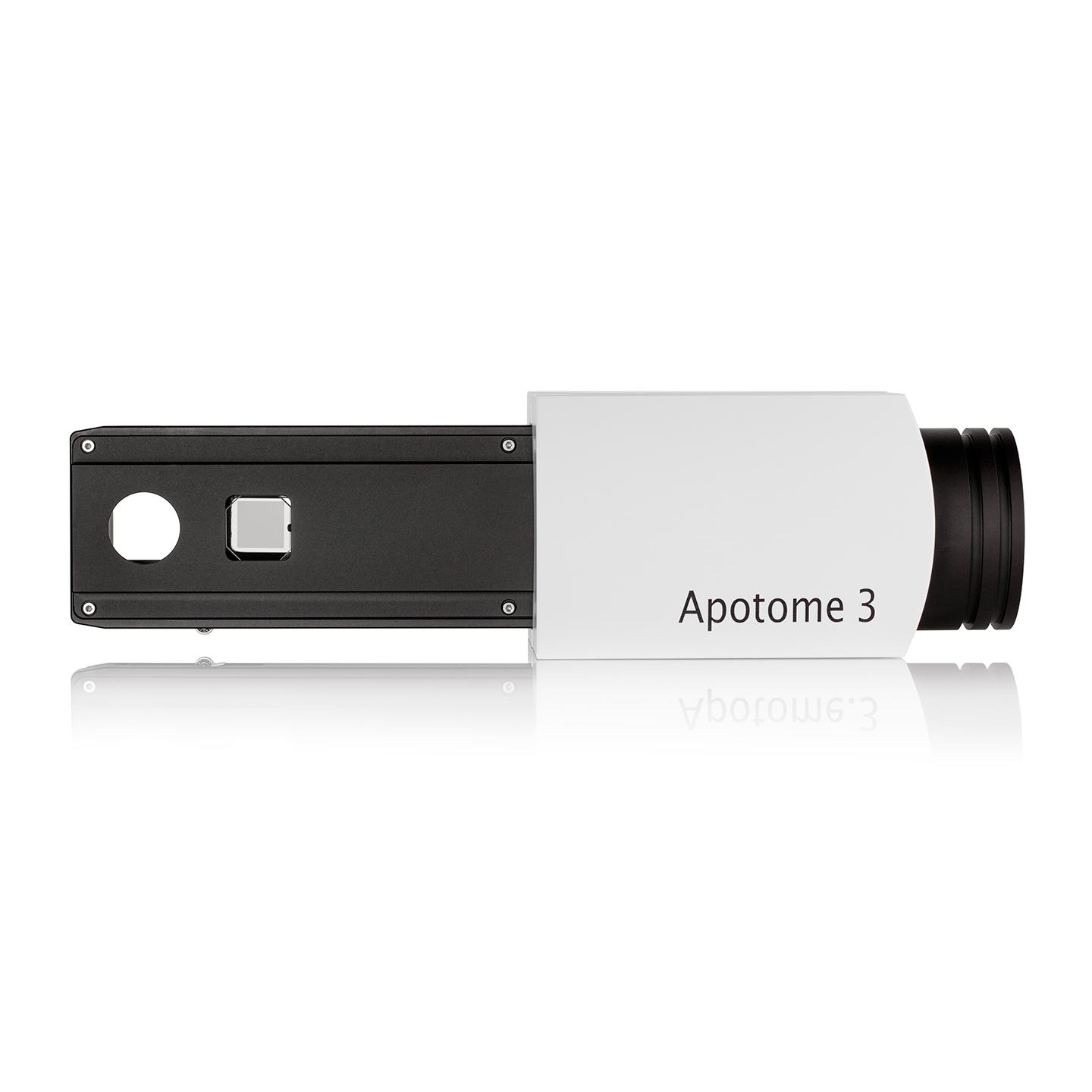
With the experienced microscopy specialist Sven Gerlach, who is responsible for ZEISS Apotome, the laboratory team faces the demanding daily task of preserving fragile receptor structures during immunofluorescence staining while generating reproducible imaging - in fixed and live cell cultures, as well as in complex, patient-derived tumor models and tissue sections.
These findings could improve our understanding of how patients respond to therapy and help identify potential diagnostic and therapeutic biomarkers.
Using Precision Imaging to Understand the Tumor Microenvironment and Cellular Mechanisms
As part of their experimental workflow, ZEISS Apotome creates optical sections, allowing for precise visualization of receptor distribution at the membrane and within intracellular compartments. It enables the team to identify localization changes caused by therapy.
The team notes that the system is an excellent choice for live imaging of 3D cell models due to its straightforward handling, large working distance, and exceptional optical quality. It maintains cell viability in a range of in vitro cancer models. ZEISS Apotome delivers reproducible imaging and high spatial resolution, significantly supporting research into the tumor microenvironment and receptor trafficking mechanisms.
ZEISS Apotome enables rapid and precise imaging of receptor dynamics, supporting biomarker discovery and translational cancer research.
Research Department laboratory of the Clinic for Urology and Pediatric Urology, Dr. rer. nat. Marco Hoffmann, 2025
Application of the ZEISS Apotome technique in prostate cancer research.
(1) FR1 staining of PCa tissue sections with linear line analysis showing increased membrane localization compared to healthy tissue.
(2) Immunofluorescence of PSMA after Enzalutamide treatment reveals distinct subcellular patterns indicated by heat-map quantification.
(3) Physiologically inspired µWells enable consistent microtumor formation from PCa cell lines and patient material, allowing high-resolution 3D imaging. Spheroidal growth of LNCaP (PCa) cells is already observed after 3 days.
Research Department laboratory of the Clinic for Urology and Pediatric Urology, Dr. rer. nat. Marco Hoffmann, 2025
Application of the ZEISS Apotome technique in prostate cancer research.
(1) FR1 staining of PCa tissue sections with linear line analysis showing increased membrane localization compared to healthy tissue.
(2) Immunofluorescence of PSMA after Enzalutamide treatment reveals distinct subcellular patterns indicated by heat-map quantification.
(3) Physiologically inspired µWells enable consistent microtumor formation from PCa cell lines and patient material, allowing high-resolution 3D imaging. Spheroidal growth of LNCaP (PCa) cells is already observed after 3 days.
Examining Effects in a Translational Context
The team's physiologically inspired µWells have revolutionized the formation and cultivation of microtumors and patient-derived prostate tumor cells. As advanced 3D in vitro cancer models, these systems effectively mimic the tumor microenvironment, maintain cell viability, and enable high resolution 3D imaging in real-time. Utilizing this µWell platform with ZEISS Apotome leads to reliable data generation in complex translational environments.
Incorporating the ZEISS Apotome Plus technique into our approach significantly improves the image quality and resolution of optical sectioning in our 3D in vitro cancer models.
Future-Ready Research
Plans to integrate live-cell imaging with automated functional readouts promise to capture dynamic receptor trafficking and ER stress in real-time and 3D.
This will bridge the gap between classical widefield fluorescence and more advanced imaging techniques. Hoffmann’s goal is to improve personalized diagnostics and therapies by accurately tracking receptor localization and the cellular response to ER stress. This approach helps them identify receptor-based biomarkers and guide treatment choices, which ultimately benefits translational cancer research and patient care.
In Brief
The primary focus of the research team at University Hospital RWTH Aachen is to study prostate cancer through the use of widefield microscopy and ZEISS Apotome, specifically investigating membrane receptors and biomarkers that play a critical role in cancer development and therapy response.
Membrane receptors, such as the folate receptor 1 (FR1) and prostate-specific membrane antigen (PSMA), are crucial for cellular communication and signaling. By studying their localization and intracellular processing, the research team gains insights into how prostate cancer cells respond to therapies, which aids in the identification of potential biomarkers and the development of targeted treatment strategies.
The research team utilizes advanced techniques such as widefield microscopy and ZEISS Apotome for precise imaging. These methods enhance the understanding of the tumor microenvironment and receptor dynamics, allowing for better data generation in complex translational environments and improving personalized diagnostics and therapies.