Unlocking the future of energy storage: Research in calcium-sulfur batteries
As the world shifts towards renewable energy sources, the demand for efficient energy storage technologies has never been more critical. Electrochemical energy storage, particularly through batteries, has emerged as a reliable solution. However, the reliance on lithium for large-scale battery production poses significant challenges, including environmental concerns associated with lithium mining and the finite availability of this essential resource.
The dedicated team of researchers at the NMI Natural and Medical Sciences Institute at the University of Tübingen is making significant strides in the field of calcium-sulfur battery research. By utilizing inert shuttle technology, they are able to conduct precise analyses, all in pursuit of developing sustainable energy storage solutions.
Exploring efficient energy storage alternatives: Calcium and sulfur
To address these challenges, Dr. Birgit Schröppel, Marco Kögel and their colleagues at the NMI Natural and Medical Sciences Institute at the University of Tübingen in Germany, are investigating the use of calcium and sulfur as active materials for next-generation batteries. Both elements are abundant in the Earth's crust, making them attractive alternatives. With theoretical volumetric capacities and reduction potential comparable to lithium, calcium-based batteries offer a promising avenue for sustainable energy storage.at the University of Tübingen
Their research delves into the interfacial reactions between electrodes and electrolytes in these battery systems. Understanding the formation mechanisms, composition, and stability of the solid electrolyte interphase (SEI) is crucial, as it plays a vital role in stabilizing the electrode and preventing degradation.
Tackling degradation issues
In electrochemical energy storage systems, such as calcium-sulfur (CaS) and well-established lithium-ion batteries, charging and discharging are driven by critical electrochemical reactions at the interfaces between electrodes and electrolytes. The research focuses on understanding these interfacial reactions, particularly in calcium-sulfur batteries, which currently face rapid capacity loss after just a few charge-discharge cycles.
The degradation mechanisms likely stem from side reactions occurring at the surface of the calcium anode, making it a crucial area for optimization. These reactions involve interactions with the known polysulfide shuttle and degradation products from the electrolyte. Such interactions can lead to passivation of the anode, which interrupts the flow of ions between the electrodes.
By identifying and optimizing these degradation mechanisms, the NMI researchers aim to enhance the stability and lifespan of calcium-sulfur batteries, paving the way for their broader adoption in energy storage applications.
Investigation of a passivation SEI
A CaS battery cell was provided by DLR for post-mortem analysis. During charging, particle-like calcium deposits formed on the anode surface as a result of electrochemical plating. At the NMI, a cross section was prepared by a focused ion beam (FIB) milling. Energy-dispersive X-ray spectroscopy (EDX) scans revealed a solid electrolyte interphase (SEI) layer formed on top of the particles.
The SEI is formed by parasitic reactions between the calcium surface and electrolyte degradation products. This passivating layer progressively blocks ionic transport at the anode–electrolyte interface, potentially interrupting ion exchange between the electrodes and limiting cell performance.
SEM image of a calcium anode extracted from a charged Ca–S battery. The surface exhibits localized electrochemical calcium deposition in particle-like structures. A focused ion beam (FIB) cross-section of one representative particle is shown in the right image for detailed analysis of local chemistry and solid electrolyte interphase (SEI) formation.
Focused ion beam (FIB) cross-section of a particle-like deposit formed on the calcium anode surface (see left image). A protective carbon layer was deposited prior to milling. Energy-dispersive X-ray spectroscopy (EDX) elemental maps reveal the presence of an SEI layer containing oxygen, fluorine, and sulfur species on the particle surface.
Fabrication of thin calcium anodes
Thin calcium anodes were developed via controlled electrochemical deposition at the fem Research Institute.
The morphology of the plated calcium layer was characterized using scanning electron microscopy (SEM) at the NMI.
To investigate the crystalline structure at high spatial resolution, a focused ion beam (FIB) lamella was extracted from an individual deposited particle. This specimen was analyzed using high-resolution transmission electron microscopy (TEM), which yielded atomically resolved structural information.
SEM image of an electrochemically plated calcium layer developed as a thin anode material for Ca–S batteries. The morphology shows a particle-like growth of deposited calcium.
Transmission electron microscopy (TEM) image of a FIB-prepared lamella extracted from a particle grown on the thin calcium anode shown above (right image). The particle consists of nanoscale crystallites, indicating a polycrystalline microstructure of the deposited calcium and/or reaction products.
For highly reactive metals, such as calcium and lithium, it is crucial to transfer samples into the electron microscope under strictly inert conditions, preventing unwanted reactions with air and moisture.
Preserving sample integrity with inert conditions
The analysis of battery materials presents unique challenges. Electrochemical reactions occur in complex, multi-component systems, making it difficult to interpret their origins and mechanisms. For instance, reactions at the anode surface are not homogeneous. Initial investigations at the NMI revealed that material growth is localized and primarily forms particle-like structures. However, elemental analysis of their cross-sections cannot always clarify the sources of the materials or the SEI's detailed composition.
The ability to transport all ZEISS sample holders enables flexible and efficient analysis workflows. For the preparation of multiple samples or lamellae, only a single inert transfer is required, significantly reducing handling steps and risk.
Additionally, sample preparation is critical; handling materials under inert conditions is essential to identify and avoid artifacts that could distort results. Inert conditions are vital for preserving the original electrochemical state of battery materials. Calcium anodes, for example, oxidize rapidly upon exposure to air, which can lead to misleading results.
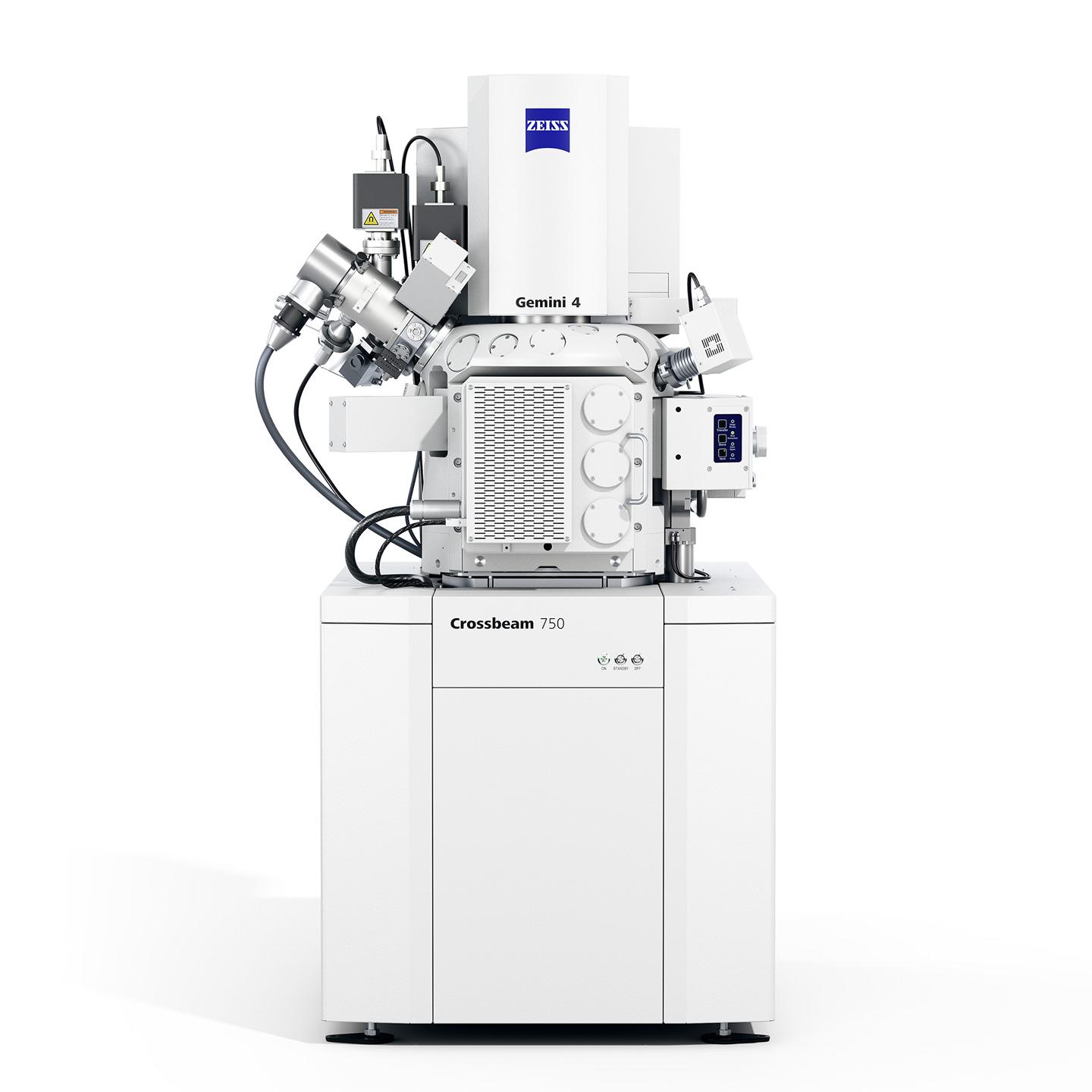
The ZEISS Uniport protect inert shuttle solution now allows for sample transfer under an argon or vacuum atmosphere instead of the former nitrogen inert gas. Nitrogen is also known to slowly react with reactive metals. This capability is crucial for obtaining accurate and meaningful results from the analyses.
By maintaining strict inert handling protocols, the team ensures that their findings are reliable and reflective of the true chemistry at play.
This setup allows us to fully utilize the capabilities of the ZEISS Crossbeam 350, including ToF-SIMS and the femtosecond laser, while maintaining stable inert conditions throughout the workflow.
Looking ahead: Developing in-situ model systems
A key focus of the future work is the development of an in-situ model battery system for electron microscopy. This innovative approach would enable real-time observation of interfacial reactions during battery operation, providing insights that are currently unattainable through traditional post-mortem analysis.
To overcome existing obstacles, the field requires true operando electron microscopy platforms that allow for electrochemical cycling under realistic conditions. By enabling direct observation of mechanisms at the micro-, meso-, and nanoscale, they can capture critical early-stage phenomena, such as SEI formation, that are essential for improving battery performance.
The SEI has a very complex chemical composition and structure. Advanced correlative microscopy combines structural, chemical, and electrochemical information to provide deeper insights by leveraging their synergy.
An artificial SEI can transform interfaces into functional components that stabilize electrochemical reactions and prevent parasitic side reactions. These artificial layers could enable reproducible cycling behavior, longer lifetimes, and higher coulombic efficiencies for calcium–sulfur systems and other multivalent metal batteries.
Innovations in energy storage for a greener tomorrow
The NMI's research into calcium-sulfur batteries represents a significant step towards sustainable energy storage solutions. By addressing the challenges of battery degradation and exploring innovative technologies, they are paving the way for a cleaner, more efficient energy future. As they continue to push the boundaries of scientific knowledge, the potential for transformative advancements in energy storage is within reach.
2026,
NMI Reutlingen
About the NMI Natural and Medical Sciences Institute at the University of Tübingen
The NMI is a pioneering research institute within the Innovation Alliance Baden-Württemberg in Germany, dedicated to advancing application-oriented research at the intersection of biological and materials sciences. With a diverse team of scientists, the NMI focuses on developing and commercializing innovative technologies for various sectors, including pharmaceuticals, biotechnology, biomedicine, materials science, and analytics. The ultimate aim is to translate cutting-edge knowledge and technology into practical applications that benefit companies and public research organizations.
At competence center of the NMI is the Nanoanalytics Center – a state-of-the-art facility specializing in the analysis of the smallest structures. This center provides invaluable insights into atomic interactions and compositions, utilizing advanced equipment to explore a wide range of length scales – from centimeters down to the atomic level.
Acknowledgments
The work includes analyzing battery samples from the CaSino project in collaboration with partners from the German Aerospace Center (DLR), and the fem Research Institute.
The CaSino project received financial support from the Bundesministerium für Bildung und Forschung (BMBF) under grant number 03XP0487D.
In brief
The main challenges with lithium-based batteries include environmental concerns related to lithium mining and its finite availability. The Nanoanalytics Center team at the NMI Natural and Medical Sciences Institute at the University of Tübingen is investigating calcium-sulfur (CaS) batteries as an alternative. Calcium and sulfur are abundant in the Earth's crust and offer theoretical volumetric capacities and reduction potentials comparable to lithium, making them promising for sustainable energy storage.
Calcium-sulfur batteries experience rapid capacity loss after just a few charge-discharge cycles due to degradation mechanisms stemming from side reactions at the calcium anode's surface. These reactions can lead to passivation, interrupting ion flow. The NMI researchers are focusing on identifying and optimizing these degradation mechanisms to enhance the stability and lifespan of calcium-sulfur batteries, thereby facilitating their broader adoption in energy storage applications.
The NMI Natural and Medical Sciences Institute at the University of Tübingen uses inert shuttle technology, specifically ZEISS Uniport protect, to transfer samples under an argon or vacuum atmosphere, preventing unwanted reactions with air and moisture. This technology is crucial for preserving the original electrochemical state of battery materials, ensuring accurate analysis. Looking ahead, the NMI plans to develop in-situ model battery systems for real-time observation of interfacial reactions during battery operation, providing deeper insights into mechanisms that could improve battery performance.