Film & Digital Times: Christophe Casenave about Aatma lenses
This interview was first published in Film & Digital Times 133-134
Christophe Casenave is the Head of Business Unit Cinematography, working at ZEISS headquarters in Oberkochen, Germany. He joined ZEISS in 2012 as a Senior Product Manager leading development of ZEISS Otus, Milvus and Loxia lenses. By 2016, he was managing and introducing cine lenses and products: CP.3, Supreme Prime and Radiance lenses, eXtended Data, CinCraft Scenario camera tracking, etc.


Christophe Casenave, Head of ZEISS Cinematography. Taken with Aatma 65mm at T1.5. All photos in this article by Andreas Bogenschütz.
Jon: How did the idea for ZEISS Aatma lenses begin?
Christophe: The concept originated about five years ago when we were developing Radiance lenses. They have been very successful, maybe because it’s a surprise for people to see ZEISS doing something with more character. We wanted to offer something else like that. Two years ago we wondered how to surprise people even more and asked why old ZEISS Super Speeds are so admired. The answer is that they share qualities that you can also recognize in the old ZEISS Contax lenses. They are not dirty or soft; they have a very strong and special character. So we said, let’s go into this direction for the new Aatma lenses.
When did you green-light the project?
June 2024. Everything was very well defined before that and we started to work full speed.
That’s very quick. What is the connection with Contax?
The connection is really the over-corrected look of ZEISS Contax lenses made in partnership with Yashica for still photography in the 1970s. ZEISS Super Speeds, also introduced in the mid 1970s, were inspired by these Contax lenses as well. This over-correction is like having multiple sets of lenses because you can change the amount of character you want in the image by setting the iris: wide open gives you the most character and as you stop down it is reduced.
How would you define character in a lens?
Character is something that surprises you. Character is something that generates questions, it’s not expected, it’s different. You say someone is a character because they do unexpected things. Perhaps they are exciting, irritating, mysterious or something else. A character actor has a unique persona.


Swapping Aatma lenses in Paris on the demo film Welcoming Grace: First AC / Focus Puller Eléa De Celles and 2nd AC Louise Autain.
Why didn’t you just rehouse old ZEISS/Contax lenses?
The character was nice, but these photo lenses had pronounced focus breathing. Also, the optical elements were made with lead and we are not allowed to use that anymore.
How did you come up with the name Aatma?
We were looking for a name that suggests character, something that is out of the ordinary, with a bit of soul. Our colleague Sundeep Reddy, who is originally from India, said, “In Sanskrit, Aatma means ‘the soul.’”
When you launched the ZEISS Radiance lenses, you compared them to Pessac-Leognan wine from Bordeaux. Aatma lenses remind you of which vineyard?
Perhaps something a bit more rustic. Aatmas remind me of Irouléguy, from the Basque Country and one of the smallest vineyards in France.
(Jon’s fingers feverishly searching the archives)
Eric Asimov of the New York Times seems to agree, writing about Irouléguy almost the way you or a DP talk about the character of a lens:
...The taste is almost like blood and iron, with rocks thrown in for good measure. Amid the parade of banality, Irouléguy stands out as a formidable wine of great character.
I know Irouléguy because I go to this region quite often. The wine is unusual, something very special that goes against the standards.
Are you building Aatma lenses in an artisanal way as well?
Yes. This is an interesting topic. It’s completely removed from the world of serial mass production that we have been used to. With Aatmas, we’re making smaller quantities of a very special item. It’s a different way of working. The entire production team was excited because it’s something they have never done before. Instead of having an assembly production line, they reshuffled the whole space, that you have seen, and instead of having three or four people working on each lens, the Aatmas are assembled by one person. In other words, each lens is crafted by one individual.
The whole team had to retrain for this. In the past, we asked them to assemble lenses as best they could. Basically, best was only limited by the optical design. Essentially, there was only one parameter to adjust: MTF. As long as the lens was sharp, clean and mechanically smooth, few people would complain.
With Aatmas, we’re asking the team to build the lenses exactly as defined within a very narrow corridor of assembling, measuring and adjusting.
They need to adjust many more parameters. It’s another world, very different. It’s all about making something that looks different, that has character, that sometimes might look not as sharp, not as “perfect,” but it’s 100% reproducible. Nothing is random. It’s all super well-defined, and this makes it much more complex to build. So, with ZEISS Aatma lenses, we do imperfections perfectly. Or, you could say, we perfectly implement imperfections.
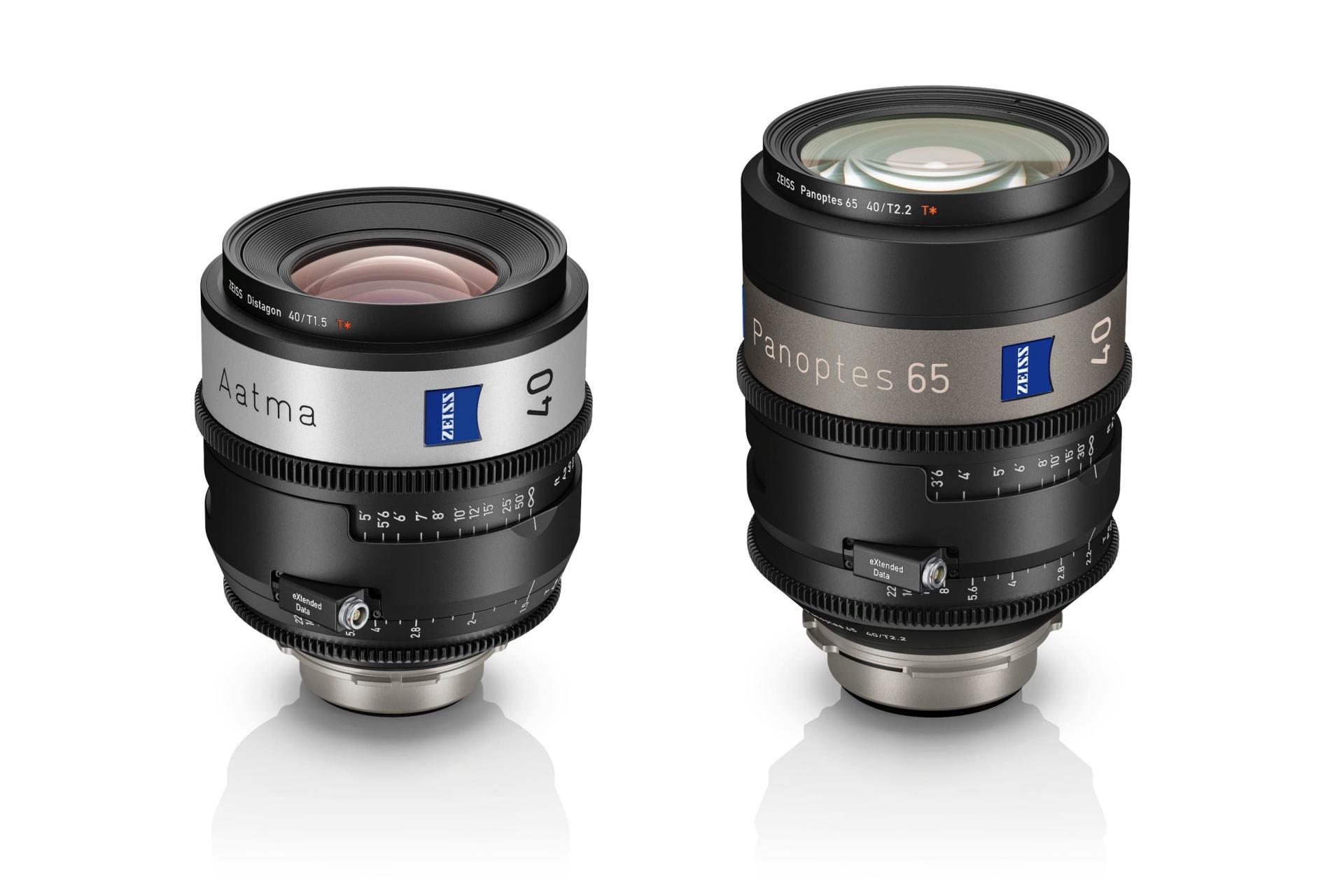

Aatma 40mm, Panoptes 65 40mm
The range of cine lenses at ZEISS keeps expanding.
The earth will not stop rotating. It’s really a commitment and we know that our market is changing. New things are happening; there are new entrants. That’s the way of business. Within our cinema business, we have diversified the portfolio. We have entry level, mid-level and “major motion picture” level cine lenses for everyone from content creators and independents to owner-operators, rental houses and production companies.
The new Aatma lenses will bring more character with a high-end touch. And stay tuned for additional, new ZEISS cine lenses.
Around BSC Expo time, we’ll tease you with 65mm format lenses: Panoptes 65.
Panoptes as in Greek mythology for “all-seeing?”
Yes, the all-seeing giant.
ZEISS Panoptes 65 will be a set inspired by our modern Full Frame lenses. They cover the larger sensor area of ALEXA 265, ALEXA 65, Blackmagic URSA Cine 17K 65, Fujifilm GFX Eterna 55, etc. There will be 10 focal lengths: 25, 35, 40, 45, 55, 70, 90, 110, 135 and 180 mm — all T2.2.