How ZEISS technology is advancing personalized cell therapies to fight cancer
1 February 202610 minread
Cancer affects more than 20 million people worldwide every year, bringing profound emotional and physical burdens to patients and their families. The real challenge, however, is not only treating cancer in general, but treating each patient individually. Tumors differ in their biology and response to therapy, yet traditional treatments have long followed a one-size-fits-all approach. Personalized cell therapies are changing this. By using a patient’s own immune cells to specifically target cancer, therapies such as CAR-T represent a more precise and individualized way of treatment. Making these therapies reliable, scalable, and safe requires advanced automation and real-time cell monitoring. This is where ZEISS microscopy technology enables a new level of precision.
At the Bosch Health Campus in Stuttgart, a new Optima Pharma machine equipped with 3D live cell microscopy technology by ZEISS Research Microscopy Solutions represents a step toward exactly that future: a more automated, reliable, and advanced cell therapy for cancer treatment. Heidelberg University Hospital collaborated with all partners throughout the entire process: an innovative medical center – just like the Bosch Health Campus – that stands for the medicine of tomorrow.
Prof. Michael Schmitt, hematologist-oncologist at the leading clinical center in Heidelberg, who collaborated with all partners in this project, emphasizes that “ZEISS has made a major contribution to the quality of the device” – without which this immense step forward in the successful fight against cancer would not have been possible.
Technology at the core
The story begins in Schwäbisch Hall, a small city in southern Germany, inside one of Optima Pharma’s production halls, where two experts have come together to take a closer look at a system that will significantly shape the future of cancer treatment: Vilma Methner, Optima Pharma's Senior Market Development Manager, and Dr. Kathrin Baader Böpple, ProCell for Patient Team Lead at the Bosch Health Campus (on the picture, from left to right).
Third-party Content Blocked
The video player is blocked due to your cookie preferences. To change the settings and play the video, please click the button below and consent to use of "Functional" tracking technologies.
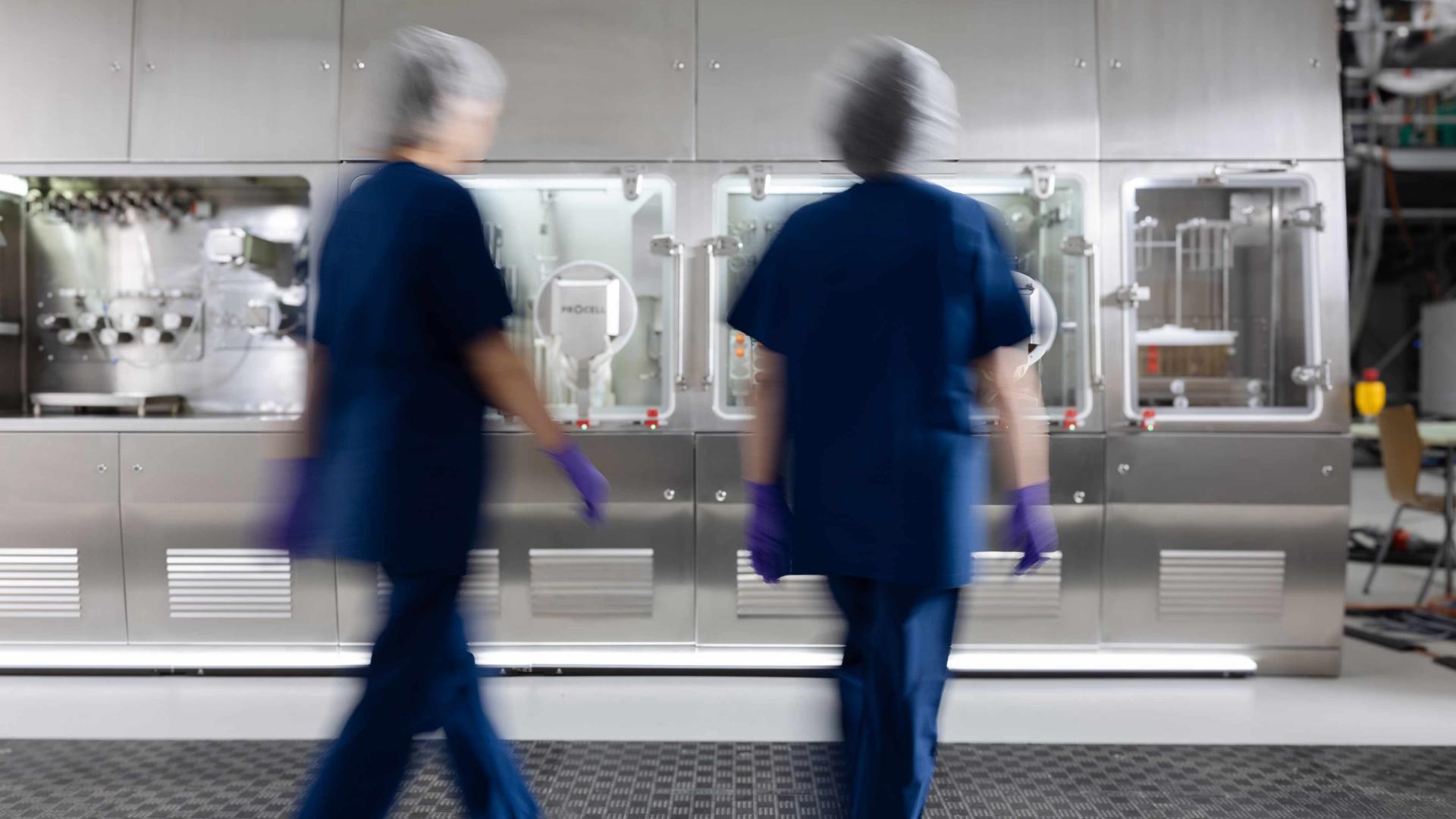
A unique system representing the future of personalized medicine is about to be delivered from here: the ProCell machine. This compact, automated manufacturing system is designed for producing so-called CAR-T cell therapies. Developed by the ProCell for Patient consortium and powered by ZEISS microscopy technology, this system enables researchers and clinicians to produce cell therapies for cancer treatment more efficiently and precisely than ever before due to automation of the process instead of manual manufacturing.
Global Cancer Statistics and Therapy Advances
~20 million
new cancer cases worldwide each year.1
45,000
patients worldwide have received CAR-T therapy.
10x
increase in manufacturing capacity through automation.
Together with Prof. Michael Schmitt from Heidelberg University Hospital, they formed a triad for this project, uniting technology, medicine, and clinical translation. Each of them brings something different to the table: medicine, engineering, research and innovation. What unites them is a shared vision: to transform the way we fight cancer. But let's briefly clarify what CAR-T cell therapy actually is and how it can fight and defeat cancer. CAR-T therapy does not begin with machines but with individual patients. Prof. Schmitt describes the process: “The core idea of CAR-T cell therapy is to repair a patient’s immune deficiency by engineering their own white blood cells to recognize and attack cancer cells.”
The impact of CAR-T cells is very high. They spark new hope for patients diagnosed with certain types of cancer and are a game-changer for the entire health system.
Schmitt explains how this works: First, blood is collected from the patient. Then, the white blood cells are extracted from the patient’s blood, activated before being genetically reprogrammed and modified to recognize cancer. These new cells, so-called CAR-T cells, are then multiplied, and injected back into the patient – summarized in very simplified terms.
They will then hopefully kill the cancer cells in the body and enable the patient to recover. “This kind of therapy is a quantum leap, a true game changer in how we treat cancer. CAR-T cells are a remarkable example of how science can turn hope into healing,” emphasizes Schmitt
Engineering precision: The power of automation
For Vilma Methner, Senior Market Development Manager at Optima Pharma, the collaboration with ZEISS is key: The ProCell unit is equipped with an integrated ZEISS Axio Observer microscope, forming the optical foundation of the system. The ZEISS microscope allows real-time monitoring of living cells, evaluating their morphology, growth, and vitality. This guarantees that every therapy meets the highest standards of precision and safety before reaching a patient.
Automation is central to the system: ProCell automatically adapts process parameters and adjusts conditions based on real-time live-cell imaging of CAR-T cells. Media changes, monitoring steps, and critical quality controls occur without manual handling. Vilma Methner has spent her entire career building bridges between biotechnology and automation. She knows that precision engineering can change lives, especially when there is a shortage of skilled personnel. Methner sums it up clearly: “Automation is not just about efficiency. It's critical for reliable, scalable access to these therapies.”
The challenge for the project team was to convert a manual process into a fully automated one. We had to understand and adapt every step of the manual cell therapy process.
By embedding ZEISS technology into Optima Pharma’s automated systems, the production process becomes not only faster but also smarter: AI-driven imaging distinguishes between living and dead cells, ensuring that only viable, healthy cells are injected into patients. For Methner, this project is not only a technological achievement, but also a human one. “Our project goal,” she says, “is to make therapies safer, faster, and more accessible to as many people as possible.”
For Dr. Kathrin Baader Böpple, decentralization is key to the future: “Our project involves the development of a decentralized point-of-care manufacturing unit for the automated point-of-care production of CAR-T cells.” New cleanroom facilities are currently being prepared for the installation of the ProCell unit at the Bosch Health Campus in Stuttgart. Once validated, automated CAR-T production is expected to begin there.
Realizing a vision at the Bosch Health Campus
Dr. Kathrin Baader Böpple, the team lead for the “ProCell for Patient” project at the Bosch Health Campus, is preparing to integrate the ProCell unit, which is equipped with ZEISS confocal microscopy technology for immunotherapy. “Given my background in cancer research, I am committed to do meaningful work that ultimately benefits patients and ideally enables them to live longer”, she describes. Her vision is bold: to bring CAR-T cell manufacturing directly to hospitals, making it more accessible, quicker, and more affordable for patients.
Instead of chemotherapy for everyone, there will be increasingly more personalized therapies. This will significantly improve the patient’s outcome.
She explains: “Automation is important for improving product quality and reducing costs in highly complex environments, enabling more patients to benefit from this form of therapy.” Automation and ZEISS low phototoxicity imaging technology play a crucial role. “A major opportunity,” she emphasizes, “is to integrate sufficient process control into the machine so that successful cell production can take place without manual processing steps.”
The Bosch Health Campus has decades of experience in GMP-manufacturing (a term for a standard: “good manufacturing process”) of blood products and acts as a bridge between medical research, clinical care, and industry: “In the future, personalized medicine is only conceivable through innovative technology and automation. That's why we decided to commit fully and join ProCell for Patient as a consortium leader.”
Where science meets human dedication
Now, shifting the focus to Heidelberg University Hospital, a leading clinical center for CAR-T cell therapy in Europe: Here, hematologist-oncologist Prof. Dr. Michael Schmitt, who has more than three decades of experience, provides insight into the therapy's medical and scientific dimensions.
For Schmitt, fighting leukemia was also a personal motivation. Many years ago, his cousin fell ill with this disease, which was "a hard time for the entire family," as Schmitt recalls. Unfortunately, this treatment option did not exist at the time, and he died. This was the moment when the young doctor Schmitt decided “to become part of the fight against cancer.”
Schmitt believes that innovation and teamwork go hand in hand: “At Heidelberg, we’ve always been pioneers. After decades of researching stem cells and vaccines, developing our own CAR-T cells felt like the next logical step. But one that required collaboration across disciplines.”
Previous CAR-T manufacturing methods were manual and involved leukapheresis, centrifugation, activation, genetic modification, cell expansion, and several safety tests. This process can take up to three weeks and requires significant expertise.
Reflecting on the evolution of the field, Schmitt adds: “In 2018, we started with only three patients; till today, around 400 patients have been treated in Heidelberg, many of whom arrive after chemotherapy and radiation have failed. Across Germany, approximately 4000 people have received CAR-T cell therapy, and around 25,000 people have received it in Europe.” For Schmitt, every patient who benefits from these therapies is a reminder of why this work matters. “Between 25 and 40 percent of patients treated with cell therapy will be cured afterwards.”
Although ProCell has not yet been installed in Stuttgart, discussions with the clinical team have highlighted how automated systems could support future demand. Heidelberg's pioneering work includes developing their own CAR-T constructs, including third-generation therapies, as well as treatment.
Impressions
The future of cancer treatment
Automation, advanced imaging, and collaborative structures are expected to define the next decade of cell and gene therapy. A strong foundation for the continued development of personalized cancer treatments is formed by the combination of engineering from Oberkochen and Schwäbisch Hall, translational research expertise from Stuttgart, and clinical excellence in Heidelberg.
Schmitt remains optimistic about the field’s trajectory: “I’m certain that within the next decade we’ll overcome the challenges of solid tumors. Personalized medicine will only grow and with it, the hope we can give to our patients.” Baader Böpple shares this optimism, stating: “Personalized medicine has the potential to make cancer treatment more effective, safer, and more patient friendly. In the long term, at best, it will improve the patient’s quality of life.”
Three perspectives, one shared mission: making personalized medicine a reality. Enabled by ZEISS technology, powered by Optima Pharma’s engineering, and guided by the teams in Stuttgart and Heidelberg, this collaboration brings together precision and purpose. Step-by-step, they are shaping a new standard in cancer therapy.
In focus: Customized microscopy solutions from ZEISS
CAR-T cell therapy reprograms a patient’s immune system to recognize and destroy cancer cells. In this autologous cell therapy approach, a patient’s T-cells are first tracked, extracted, and isolated through leukapheresis. These immune cells are then genetically engineered to express a Chimeric Antigen Receptor (CAR) – a synthetic receptor designed to identify cancer-specific antigens and overcome challenges of the tumor microenvironment.
During the T-cell engineering workflow, cells undergo activation, transduction, and expansion. Throughout this process, ZEISS microscopy technology supports GMP-compliant cell inspection, allowing scientists to monitor each cell’s morphology, viability, proliferation, and transfection efficiency in real time. Automated imaging enables automated cell counting for CAR-T, in-vitro validation, and high-precision volumetric imaging of the developing cell product.
To ensure patient safety, every manufacturing step undergoes rigorous sterility testing, particulate matter detection, mycoplasma detection, and visual inspection procedures aligned with USP 790 and other global GMP standards. After expansion, the engineered CAR-T cells are multiplied, cryopreserved, and re-infused into the patient, where they seek and eliminate cancer cells with high specificity and potency.
Automation ensures consistency, GMP compliance, and scalability, while ZEISS optical systems provide real-time cell analysis and imaging precision. Together, these technologies enable reliable, high-quality CAR-T cell production at a reduced cost.
ZEISS Axio Observer microscopy allows for the real-time analysis of cell morphology, growth, and viability within the Optima Pharma ProCell. When combined with AI-based image classification, it allows for adaptive control of manufacturing steps and improved product reliability.
The Optima Pharma ProCell system enables the nearly fully automated, parallel production of multiple CAR-T cell therapy batches. It reduces the required cleanroom space by 61% and the number of required specialized personnel. The system also integrates ZEISS imaging technology to enable patient-specific process adjustments.
This triad unites technology, medicine, and clinical translation. ZEISS provides the imaging foundation for the Optima Pharma system. Bosch Health Campus develops decentralized production units. Heidelberg applies therapies to patients, creating a complete ecosystem for the future of cancer treatment.