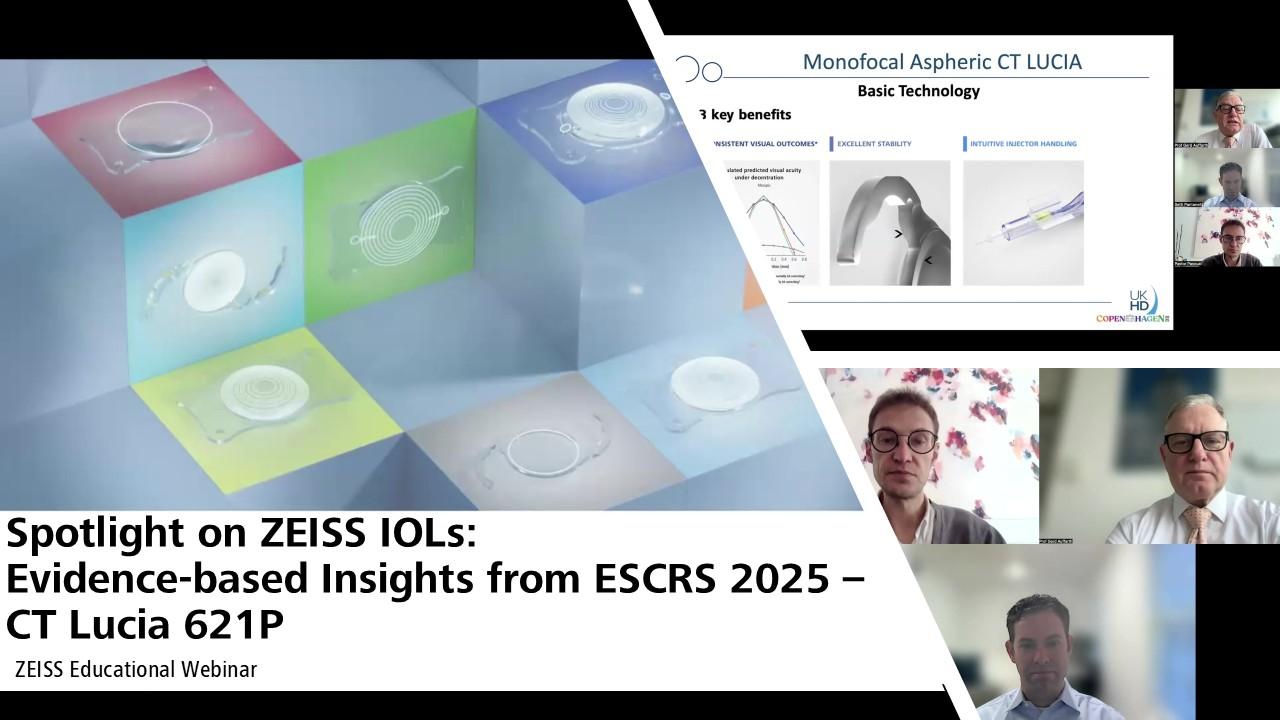
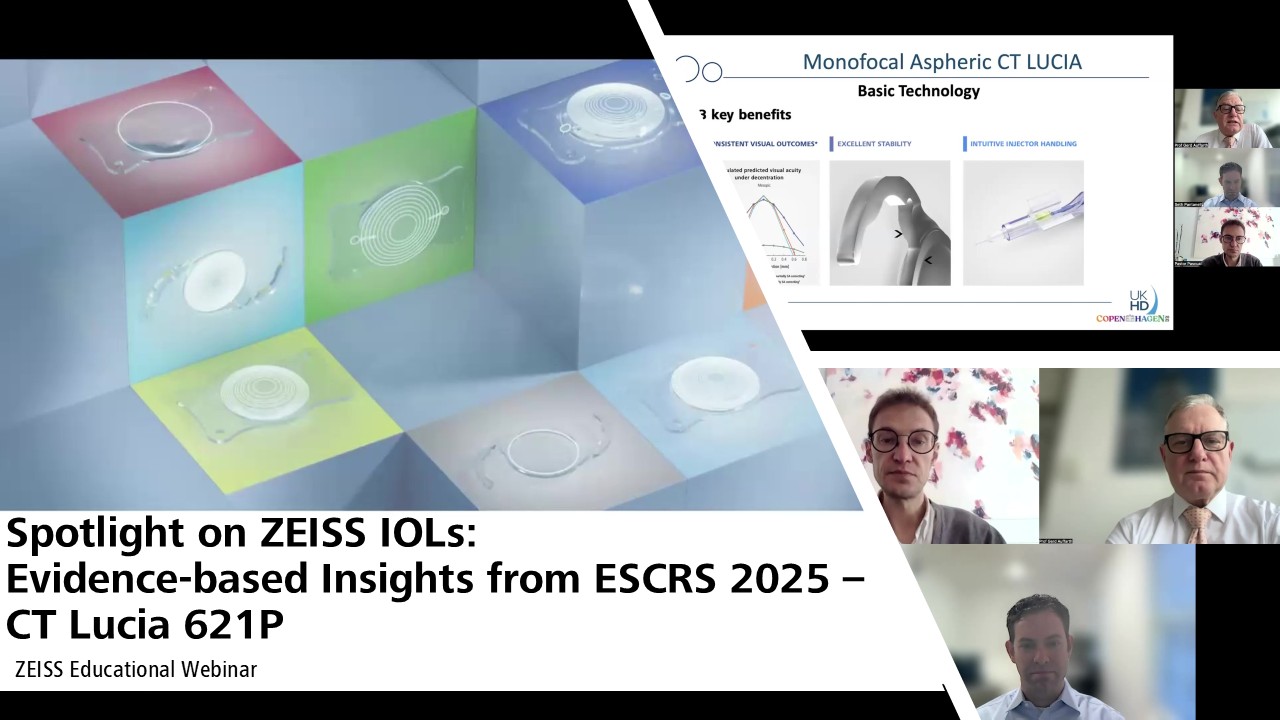
Spotlight on ZEISS IOLs 2025 - Part 1
Spotlight on ZEISS IOLs: Evidence-based Insights from ESCRS 2025 on CT LUCIA 621P

Director of the David J. Apple International Laboratory for Ocular Pathology, and Director of the International Vision Correction Research Centre (IVCRC).


Penn State College of Medicine, Hershey, PA, United States


Spotlight on ZEISS IOLs:
Evidence-based insights from ESCRS 2025
In this first episode of our three-part webinar series, Professor Gerd Auffarth dives together with the panel into the latest clinical insights on the ZEISS CT LUCIA 621P. Discover how this monofocal, hydrophobic, c-loop IOL can shape surgical outcomes by providing functional intermediate vision.
What you can expect from this video:
Presentation from Seth Pantanelli on “CT LUCIA 621P Monofocal IOL: Evaluation of the Visual Performance and Patient Satisfaction, a Post-Market Multicentric Study”
- Interim key findings of ongoing CT LUCIA 621P clinical trial:
- In both photopic (bright) and mesopic (dim) conditions, 100% of subjects achieved a distance visual acuity (DVA) of 20/40 or better with CT LUCIA.
- Surprisingly, with CT LUCIA almost all subjects had functional intermediate vision in bright conditions, and over 80% maintained this in dim conditions.
- The study highlighted the importance of assessing intermediate vision with monofocal IOLs, specifically the CT LUCIA 621P, which showed unexpectedly favorable results.
Presentation from Francisco Pastor Pascual on “Clinical Outcomes of a Monofocal, Optimized, Aspheric Intraocular Lens in Eyes with Different Degrees of Corneal Spherical Aberration”
- Key findings of CT LUCIA 621P ongoing clinical trial:
- Eyes were categorized based on corneal spherical aberration at a 6mm pupil size.
- No significant differences were found in visual acuity or refractive outcomes across groups based on corneal spherical aberration (SA) indication at 6mm pupil size, indicating SA does not affect lens performance.
- Patient Satisfaction:
- High patient satisfaction was reported, with 98% willing to undergo surgery again and 99% recommending it to others.
- No postoperative visual phenomena were reported, indicating successful outcomes.