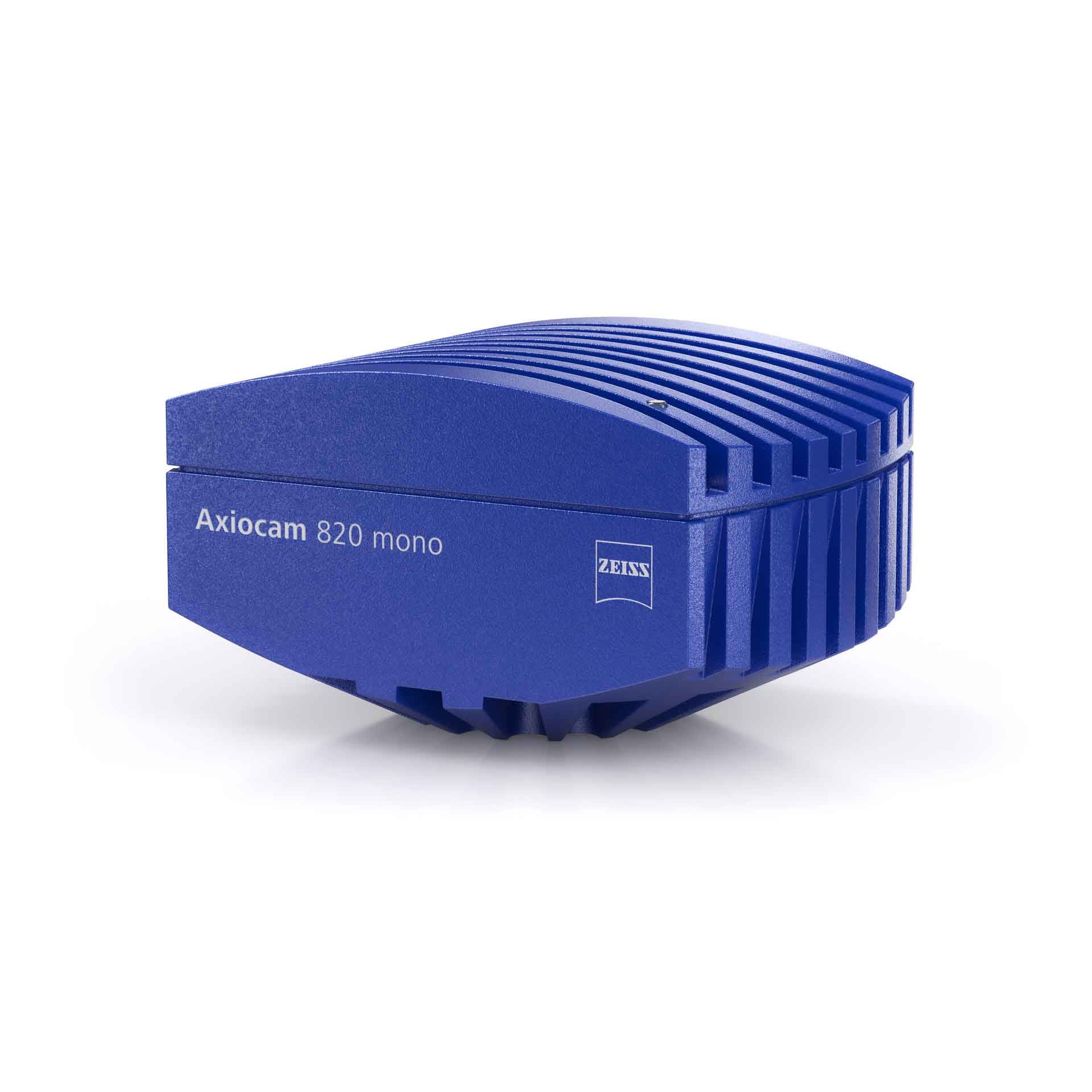
ZEISS Axiocam 925 mono
A 25-megapixel microscope camera for demanding fluorescence imagingThe ZEISS Axiocam 925 mono combines a back-illuminated CMOS sensor with a 19.3 mm image diagonal and 2.74 µm pixels, capturing large sample areas and fine details across microscope magnifications.
Up to 86% quantum efficiency, 1.3 e⁻ read noise, optional on-chip 2 × 2 charge accumulation, and noise reduction support sensitive fluorescence imaging. Active cooling and sensor temperature stabilization help ensure reproducible image quality and quantitative results.
The global shutter captures dynamic processes without rolling-shutter artifacts. Record at up to 58 fps at full pixel count or 144 fps in 2 × 2 binning mode at 6 megapixel. A 30 fps live image supports focusing and sample navigation; hardware triggering enables synchronization with external devices.
The ZEISS Axiocam 925 mono is designed for large-area and quantitative fluorescence imaging, live-cell experiments, and high-throughput workflows.
- Demanding life science fluorescence imaging, including faint signals with a good signal-to-noise ratio
- Live-cell imaging and dynamic time series
- Flexible widefield setups combining high resolution, a large field of view, high sensitivity, and high throughput
Capturing the zebrafish heartbeat like never before - trabeculae and blood flow revealed with clarity and detail.
Courtesy of Dr. Radhan Ramadass and Daiki Sugita, Max Plank Institute of Heart and Lung Research, Bad Nauheim, Germany.


Quantum efficiency
Quantum efficiency
Highlights of Axiocam 925 mono
- 25-megapixel back-illuminated CMOS sensor with a 19.3 mm image diagonal
- Up to 58 full pixel count images per second
- Up to 144 frames per second in 2 × 2 binning mode
- 30 frames per second in live image mode
- 2.74 µm pixels for resolving fine details across microscope magnifications
- Up to 86% quantum efficiency
- 1.3 e⁻ read noise, with advanced noise reduction for low-light imaging
- 400-1,000 nm sensitivity spectrum
- Global shutter and fast sensor readout for distortion-free imaging
- Active thermoelectric cooling and sensor stabilization for reproducible image quality
- Hardware triggering for synchronization with external devices
Application examples


GFP fluorescence imaging of muscle expression in C. elegans


GFP fluorescence imaging of muscle expression in C. elegans
The CL2179 strain expresses a transgenic GFP variant in its body-wall muscles. A mutation in the transgene causes an abnormal movement pattern, with the animals rolling around their longitudinal body axis. The strain was first described in PMID: 16239215.Courtesy of Dr. Andre Franz, CECAD Research Center, Institute for Genetics, University of Cologne, Germany.


Revealing finer details of GFP expression in C. elegans


A cutout of the original C. elegans image scaled up for a closer view.
Revealing finer details of GFP expression in C. elegans
A cutout of the original C. elegans image scaled up for a closer view.Courtesy of Dr. Andre Franz, CECAD Research Center, Institute for Genetics, University of Cologne, Germany.