

PRODUCT
Intelligently Illuminating
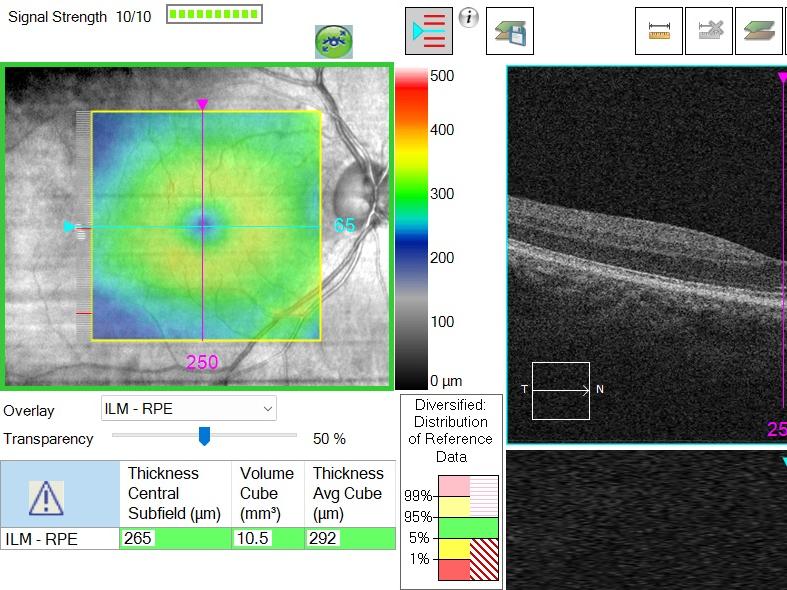
AI-guided OCT image assessment with CIRRUS PathFinderCIRRUS PathFinder1 is a fully integrated deep learning, AI-based support tool that enables more confident decision-making with OCT interpretation assistance. Designed to complement your clinical workflow, CIRRUS PathFinder streamlines the review of macular OCT scans by automatically identifying scans that may need closer review.
Know when to take a closer look
Illuminating
- Enhanced OCT scan interpretation provides improved workflow efficiency.
- Automatic image assessment highlights poor-quality scans.
- AI-enabled detection identifies OCT B-scans with macular findings such as Subretinal fluid (SRF), intraretinal fluid, retinal pigment epithelium atrophy, retinal pigment epithelium elevation, disruption of inner retinal layers, disruption of the vitreoretinal interface, inner segment/outer segment disruption.


Intelligent
- Employs deep-learning AI algorithms for increased confidence and clinical support.
- Fellow eye monitoring effortlessly tracks for changes.
- Trained on more than 75,000 OCT B-scan images.
- Validated by leading retina specialists to have 88% sensitivity and 93% specificity2.

Integrated
- Works seamlessly with CIRRUS review software.
- Can be switched on and off as required (e.g., for educational purposes).
- Empowers imagers and clinicians to capture detailed scans in undiagnosed areas.
- Provides an efficient solution for reviewing large amounts of detailed data.
How it works
CIRRUS PathFinder detects B-scans of interest within the CIRRUS Macular Cube- Acquire: Capture dense 512 x 128 Smart Cube scans of the macula, automatically centered on the fovea.
- Qualify: Assesses image quality via deep learning—performs good and poor image quality assessment.
- Detect: Determines if images are of interest with presence of eight pathologies or conditions.
- Flag: Highlights poor quality image (yellow) and B-scan of interest (red).
Videos
Downloads


Get in touch with us!
Receive more information about the product and availability in your country!-
1
PathFinder is available on all ZEISS CIRRUS devices.
-
2
Talcott E, Valentim C, Perkins S, Ren H, Manivannan N, Zhang Q, Bagherinia H, Lee G, Yu S, D’Souza N, Jarugula H, Patel K, Singh R. Automated Detection of Abnormal Optical Coherence Tomography B-scans Using a Deep Learning Artificial Intelligence Neural Network Platform. Int Ophthalmol Clin. 2024 Jan;64(1):115-127.