Funding Call

INSPIRE Programme

Research Infrastructure Investment Fund
  • Research Ireland and the Higher Education Authority are launching INSPIRE, a €750 million research infrastructure programme.
  • Funding for new, upgraded, and shared research equipment across all disciplines.
  • ZEISS supports Irish institutions with planning for funding application, technical guidance, and local service expertise.

INSPIRE Research Infrastructure Funding

Supporting Ireland’s Next Wave of Research Investment

Ireland is preparing for a major new investment in research infrastructure through the INSPIRE Research Infrastructure Programme, a €750 million initiative led by Research Ireland and the Higher Education Authority.

Open to all research disciplines, INSPIRE is a long-term funding programme designed to strengthen Ireland's research capabilities through investment in new, upgraded and shared infrastructure across the higher education sector. The programme supports the acquisition of equipment and facilities that enhance research capability, drive innovation and foster collaboration between academia and industry.

Funding is available for both institutional research equipment and larger shared infrastructure projects. Eligible higher education institutions can access detailed guidance, application requirements and supporting documentation via the official INSPIRE website. The programme will be delivered in two phases. To help you get started, we've summarised the key funding highlights below.

ZEISS is already working with Irish institutions to support early planning and engagement. In addition to providing scientific and technical guidance during project development, ZEISS offers a strong local support infrastructure with a dedicated service team, including an Ireland-based field service engineer. This ensures rapid access to technical expertise, preventative maintenance, application support and ongoing system optimisation throughout the lifetime of your investment.

Our local presence is complemented by the wider ZEISS UK and Ireland organisation, providing customers with direct access to applications specialists, service engineers, and workflow experts to maximise the impact of funded research infrastructure.

ZEISS Solutions for Phase One of the INSPIRE Programme

Here are some recommended solutions that could meet the funding application criteria, note that this is not an exhaustive list. Each application will be funded to a maximum value of €500K, inclusive of VAT. Contact us for more information.
  • ZEISS LSM 910 (with Airyscan and new Lightfield 4D)

    ZEISS LSM 910

    with Airyscan and Lightfield 4D

    In life sciences, confocal microscopes are used to visualize structures within cells and tissues, study dynamic biological processes, and analyse multi-fluorescent samples. In materials science, confocal microscopy is used to examine surface topography, analyse material composition, and investigate the microstructure of materials with high resolution. ZEISS confocal laser scanning microscopes excel with super-resolution imaging down to 90 nm, advanced 4D imaging capabilities, and has an unmatched spectral versatility.

    With the brand new Lightfield 4D add-on, you can capture deep 3D images with a single snap. Record the fastest movements within whole organisms at up to 80 volumes per second – with all spatiotemporal information intact. Crawling larvae, beating hearts, flowing blood, and firing neurons can be studied in 3D at unprecedented speed with Lightfield 4D.

  • ZEISS Sigma​ 360

    FE-SEM for High-Quality Imaging & Advanced Analytical Microscopy

    ZEISS Sigma 360 is an intuitive, high-end FE-SEM that combines outstanding user experience with advanced nano-scale imaging and analytics, making it particularly well suited for core imaging facilities. It delivers high-resolution, high-contrast images even at low voltages, enabling detailed investigation of new materials, particles for quality inspection, and biological or geological specimens without compromising image quality. With best-in-class EDS geometry, Sigma 360 provides analytical data up to twice as fast and with greater precision, significantly increasing productivity and throughput for multi-user environments.

  • ZEISS Axioscan 7

    Digital Slide Scanner

    The ZEISS Axioscan 7 is a high-performance digital slide scanner designed to deliver fast, automated whole-slide imaging with consistent, research-grade quality. For biologists, it supports brightfield, fluorescence and multiplex imaging workflows at scale; for engineers and materials researchers, it offers flexible imaging modes including polarisation, helping digitise and analyse large slide sets with speed, reproducibility and minimal manual intervention.

  • ZEISS EVO Family

    The ZEISS EVO family combines high-performance SEM imaging with an intuitive, flexible platform suited to both experienced microscopists and new users. For biologists, it enables detailed imaging of biological structures with straightforward operation and adaptable workflows; for engineers and materials teams, it supports applications from materials characterisation to routine quality assurance and failure analysis. EVO can also be integrated into semi-automated multimodal workflows, making it easier to relocate regions of interest and combine light and electron microscopy data for more connected, efficient analysis.

  • ZEISS Lattice SIM 3

    The ZEISS Lattice SIM 3 is a super-resolution imaging system designed for researchers working with multicellular organisms, tissue sections and other complex biological samples. It delivers fast, gentle optical sectioning with near-isotropic resolution, large fields of view and the flexibility to zoom in on smaller regions of interest—helping biologists capture more detail with minimal photodamage. For advanced imaging workflows, it offers high-quality super-resolution data across larger, more complex specimens without compromising speed or sample integrity.

  • ZEISS Celldiscoverer 7

    The ZEISS Celldiscoverer 7 is an automated imaging system built for researchers who need high-content data without compromising image quality. It combines ease of use with stable long-term performance, making it ideal for biologists running demanding live-cell, screening or exploratory imaging experiments at scale. With adaptable workflows and automated acquisition, Celldiscoverer 7 helps generate statistically robust data efficiently and consistently across larger studies.

  • ZEISS arivis Pro

    The ZEISS arivis Pro software gives biologists and engineers a powerful way to analyse, visualise and quantify complex microscopy datasets without the need for coding. Its flexible, AI-driven workflows support large 2D, 3D and 4D image data across multiple modalities and file formats, helping users build reproducible analysis pipelines, process high-volume datasets efficiently and turn imaging data into actionable insights.

ZEISS Solutions for Phase Two of the INSPIRE Programme

Here are some recommended solutions that could meet the funding application criteria, note that this is not an exhaustive list. Each application will be funded to a maximum value of €500K, inclusive of VAT. Contact us for more information.
  • ZEISS LSM 990

    With Lightfield 4D

    The ZEISS LSM 990 with Lightfield 4D enables instant volumetric imaging of living samples, capturing complete 3D information in a single snap at speeds of up to 80 volumes per second. For biologists, this means following fast physiological and developmental processes in whole organisms with minimal light exposure and reduced phototoxicity; for researchers working with complex dynamic samples, it offers a powerful way to image large volumes over time without sacrificing temporal accuracy. Combined with the flexibility of the LSM platform, Lightfield 4D supports advanced multimodal workflows that bring together high-speed live imaging, confocal imaging and deeper biological insight.

  • ZEISS GeminiSEM 360

    The ZEISS GeminiSEM 360 is a versatile field emission SEM designed to deliver high-resolution imaging and analytical flexibility across life sciences, materials research and industrial workflows. For biologists, it supports detailed imaging of sensitive or non-conductive samples with surface and compositional information at low voltage; for engineers and materials teams, it enables efficient characterisation of complex samples through parallel in-lens detection, configurable analytics and large-area imaging. With integration into the ZEISS ZEN ecosystem, GeminiSEM 360 can also support connected multimodal workflows, making it easier to correlate data, streamline analysis and expand capabilities over time.

  • ZEISS Crossbeam 750 FIB-SEM

    The ZEISS Crossbeam 750 is a high-precision FIB-SEM platform built for advanced sample preparation, 3D tomography and nanofabrication workflows. For engineers and materials researchers, it delivers live “see while you mill” imaging, precise endpoint control and reliable sub-20 nm TEM lamella preparation for demanding semiconductor and materials applications. For life science workflows, low-kV imaging and low-damage thinning help preserve delicate structures, while recipe-based automation and integrated SEM/FIB workflows improve repeatability, throughput and confidence across complex multimodal analyses.

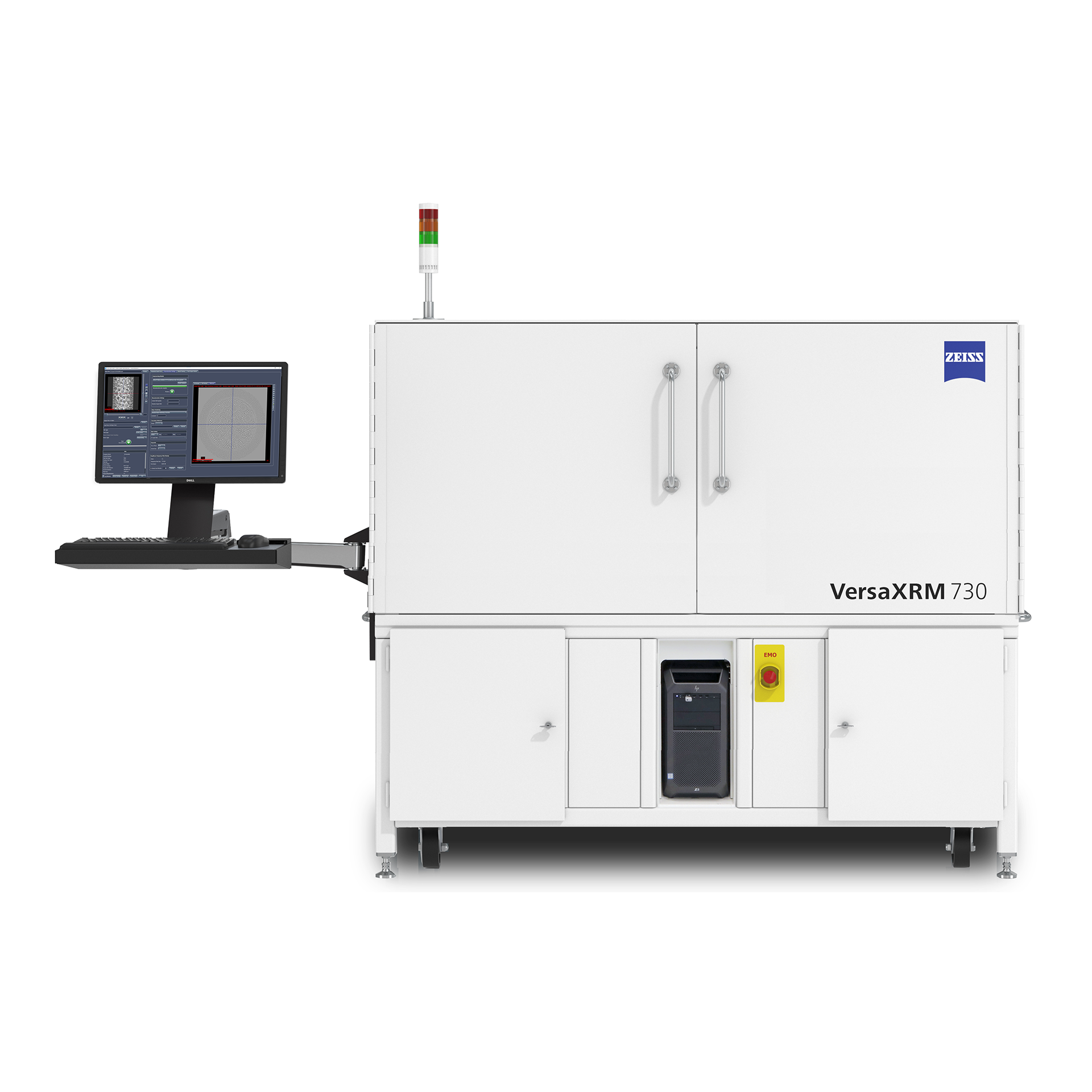
  • ZEISS Versa 730

    The ZEISS VersaXRM 730 delivers high-resolution, non-destructive 3D imaging for complex biological and materials samples. For biologists, it enables detailed visualisation of intact specimens without sectioning; for engineers and materials researchers, it provides submicron imaging down to 450–500 nm resolution for multi-scale analysis. With ZEN navx guided workflows, AI-driven reconstruction and faster tomography, VersaXRM 730 helps users generate high-quality 3D data more efficiently and with greater confidence.

  • ZEISS Elyra 7

    The ZEISS Elyra 7 is a flexible super-resolution microscope designed to reveal dynamic biological processes and molecular detail across a wide range of sample types. For biologists, it combines fast live-cell imaging, optical sectioning and super-resolution down to 60 nm, with options including Lattice SIM², SIM Apotome and SMLM to match different speed, sensitivity and resolution needs. Its ability to image thick, scattering and photosensitive samples while supporting correlative and multi-technique workflows makes it a powerful platform for extracting more insight from complex biological specimens.

Contact Us

Interested in support for an INSPIRE Fund application involving a ZEISS solution, or have questions? Complete the form below, and a representative will get in touch.

Form is loading...